
Geometric tattoos are among the most intellectually compelling — and visually striking — tattoo styles in existence. Where other styles lean on narrative or emotion, geometric tattoos speak in the universal language of mathematics, symmetry, and form. A circle. A spiral. An interlocking grid of triangles. Simple shapes, infinite meaning.
Interest in geometric tattooing has surged over the past decade and shows no signs of slowing. According to tattoo industry data, geometric and sacred geometry designs consistently rank among the top five most-searched tattoo styles globally — and the rise of AI tattoo design tools has made previously complex geometric patterns more accessible than ever.
This guide covers everything: what geometric tattoos are, every major style, the meanings behind sacred geometry symbols, placement advice, how these tattoos age, and how to find (or design) your perfect geometric piece.
What Is a Geometric Tattoo?
A geometric tattoo is any design built primarily from geometric shapes — lines, angles, circles, polygons, and mathematical patterns. These designs may be purely abstract, may incorporate representational imagery (like an animal rendered in geometric forms), or may draw from sacred geometry traditions that assign deep symbolic meaning to specific shapes and patterns.
The appeal is broad:
- Visual precision — clean lines and perfect symmetry create a distinctly modern aesthetic
- Symbolic depth — many geometric forms carry centuries of philosophical, spiritual, or mathematical meaning
- Versatility — geometric elements work at any scale, from tiny wrist pieces to full sleeves
- Timeless style — unlike trend-driven aesthetics, fundamental geometric forms never go out of fashion
Geometric tattooing isn't a single style but a broad category. The designs range from ultra-minimalist single-line triangles to densely layered sacred geometry mandalas covering an entire back.
Geometric Tattoo Styles
Linework Geometric
The most foundational style: crisp, precise lines forming shapes, patterns, or silhouettes. Linework geometric tattoos rely entirely on the quality of the line — consistency of weight, perfect angles, exact symmetry.
Best for: First geometric tattoos, minimalists, smaller placements (wrist, collarbone, behind the ear).
Design examples: Geometric animal outlines (fox, wolf, bear rendered in angular planes), geometric mandala outlines, interlocking polygon patterns.
Dotwork Geometric
Dotwork uses thousands of precisely placed dots to build form, shading, and texture without continuous lines. In geometric contexts, dotwork creates a stippled, almost ethereal quality — shapes seem to emerge from the skin rather than being drawn onto it.
Dotwork is technically demanding and slower to execute, which means it's typically priced higher than comparable linework pieces.
Best for: Sacred geometry designs, mandalas, pieces intended to look aged or ancient, those who want a softer look than black linework.
Design examples: Dotwork Flower of Life, stippled Sri Yantra, dotwork mandala with radiating geometric borders.
Blackwork Geometric
Blackwork uses bold, solid fills of black ink — entire sections of the design are flooded solid black, creating high-contrast geometric blocks. This style makes a dramatic visual statement and is particularly effective for large-scale pieces.
Best for: Bold statement pieces, large placements (ribs, thighs, back), those who want high visual impact.
Design examples: Solid black geometric sleeve, blackwork compass rose, alternating solid-black and negative space triangle patterns.
3D Geometric
3D geometric tattooing uses shading, perspective, and optical illusion techniques to make flat shapes appear three-dimensional. A cube appears to hover above the skin. A geometric sphere seems to cast a shadow. The effect, when executed well, is genuinely startling.
This style requires an artist with strong technical drawing skills and an understanding of light and shadow in addition to geometric precision.
Best for: Those who want a true showpiece, larger placements where the 3D effect can fully read.
Design examples: Floating 3D cube or dodecahedron, geometric sphere with shadow, architectural geometric structures.
Geometric Realism Fusion
One of the most popular contemporary directions: realistic imagery (portraits, animals, nature) fragmented or framed by geometric shapes. A wolf's face emerging from a shattered polygon. A rose contained within a perfect hexagon. The contrast between organic and geometric creates powerful visual tension.
Best for: Those who want symbolic meaning alongside representational imagery, sleeve compositions.
Design examples: Geometric wolf portrait, lion in sacred geometry frame, compass merged with geometric landscape.
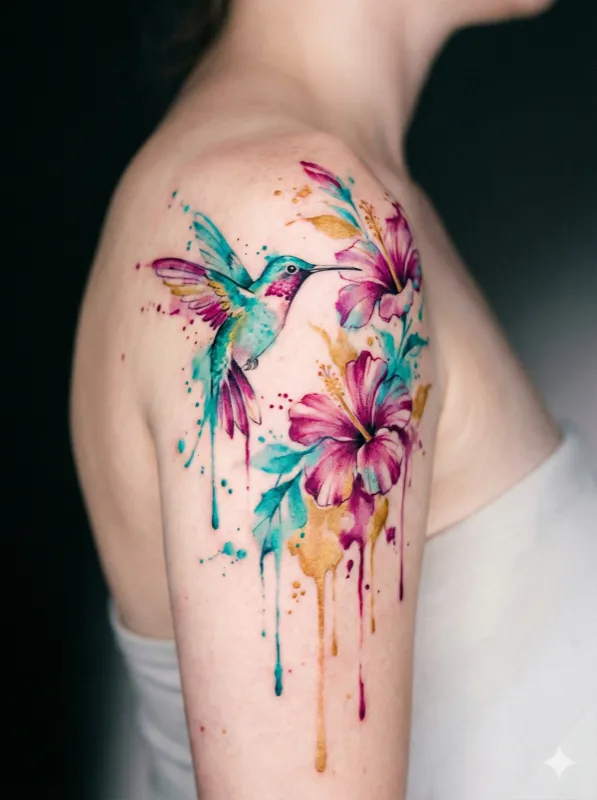
Watercolor Geometric
Watercolor-wash fills contained within crisp geometric outlines. The rigid geometry provides structure; the watercolor provides color and softness. The style bridges two very different aesthetics effectively.
Note that watercolor elements are known to fade faster than solid black linework — the geometric outlines will remain crisp while the color fill softens over time.
Best for: Those who want color in a controlled, modern framework.
Sacred Geometry Tattoos and Their Meanings
Sacred geometry refers to geometric patterns that appear throughout nature, religious architecture, and philosophical traditions across cultures — from Islamic architecture to Gothic cathedrals, from Hindu mandalas to Leonardo da Vinci's notebooks. These patterns are considered to reflect the mathematical order underlying reality itself.
Flower of Life
A pattern of overlapping circles arranged in a sixfold symmetry, forming a flower-like grid. One of the most ancient sacred geometry symbols, found in Egyptian temples, Renaissance manuscripts, and Hindu temples alike.
Meaning: Unity, interconnection, the underlying pattern of all life. Each circle represents a single life or consciousness; together they form a unified whole.
Metatron's Cube
Derived from the Flower of Life, Metatron's Cube connects the centers of all circles in the Flower of Life pattern, producing a complex interlocking structure containing all five Platonic solids.
Meaning: The totality of creation, divine order, the containment of all possible geometric forms within a single pattern. In Jewish Kabbalistic tradition, Metatron is the angel of the celestial realm — the cube represents his ability to contain all of creation.
Sri Yantra
A complex pattern of nine interlocking triangles arranged around a central point (bindu), surrounded by lotus petals and geometric borders. The Sri Yantra is one of the most revered symbols in Hindu Tantrism.
Meaning: The cosmos, the divine feminine, the path from the material world toward enlightenment. The nine triangles represent the union of Shiva and Shakti — masculine and feminine cosmic forces.
Fibonacci Spiral / Golden Ratio
The Fibonacci sequence (1, 1, 2, 3, 5, 8, 13...) generates a spiral that appears throughout nature — in nautilus shells, sunflower seed arrangements, galaxy spirals, and the proportions of the human body. The golden ratio (φ ≈ 1.618) underlies this spiral.
Meaning: The mathematical beauty of nature, growth, harmony, the hidden order within organic forms. Popular among scientists, mathematicians, and those drawn to natural philosophy.
Merkaba
Two interlocking tetrahedra — one pointing up, one pointing down — forming a three-dimensional Star of David. In Kabbalistic and New Age traditions, the Merkaba is a vehicle of light surrounding the human body.
Meaning: Spiritual protection, ascension, the integration of opposites (spirit and matter, masculine and feminine, heaven and earth).
Vesica Piscis
Two circles of equal size overlapping so that the circumference of each passes through the center of the other. The almond-shaped intersection is the Vesica Piscis.
Meaning: Creation, the union of two complementary forces, the feminine principle, birth. In Christian iconography, the Vesica Piscis (mandorla) surrounds depictions of Christ and the Virgin Mary.
Individual Shape Meanings
Beyond full sacred geometry patterns, individual shapes carry symbolic weight:
| Shape | Core Meanings |
|---|---|
| Circle | Wholeness, eternity, cycles, protection, the infinite |
| Triangle (point up) | Masculine energy, fire, aspiration, strength |
| Triangle (point down) | Feminine energy, water, intuition, receptivity |
| Square | Stability, the material world, groundedness, order |
| Hexagon | Balance, efficiency, nature (honeycomb), harmony |
| Pentagon | The five elements, humanity (the human form fits within a pentagon) |
| Spiral | Growth, evolution, the journey inward/outward |
| Mandala | The self, wholeness, the universe as seen from a single point |
Geometric Tattoo Placement Guide
Arm and Forearm
The most popular placement for geometric work. The cylindrical shape of the arm provides a natural canvas for designs meant to wrap around the limb, and the forearm is ideal for bold geometric pieces meant to be seen daily.
Works well: Geometric sleeve concepts, single statement pieces on the outer forearm, dotwork geometric on the inner forearm.
Chest and Sternum
The sternum is particularly well-suited to mandala-based designs that radiate outward symmetrically. The chest offers a large, relatively flat canvas for complex geometric compositions.
Works well: Sternum mandala, chest piece geometric compass, sacred geometry patterns centered on the sternum.
Back
The ultimate canvas for large-scale sacred geometry work. Full-back geometric pieces — particularly Flower of Life or Sri Yantra designs — are among the most visually ambitious tattoos possible.
Works well: Metatron's Cube, large Flower of Life, geometric landscape compositions, geometric spine work.
Thigh
The thigh offers substantial flat surface area with relatively low visibility — popular for those who want large, complex geometric pieces in a more private placement.
Works well: Large geometric mandala, 3D geometric shapes, geometric floral fusions.
Minimalist Placements (wrist, ankle, behind ear, collarbone)
Smaller geometric shapes work beautifully in these high-visibility but small-footprint placements. A single triangle, a small Fibonacci spiral, or a simple mandala outline can be elegant in these spots.
Caution: Very small dotwork geometric designs can lose detail over time as dots migrate slightly. Fine linework holds better in small formats.
Do Geometric Tattoos Age Well?
This is one of the most common questions — and the honest answer depends heavily on style and placement.
Linework geometric: Ages quite well. Bold, clean lines in solid black ink are among the most durable tattoo styles. Avoid very thin single-needle lines if longevity is a priority, as these can fade or blur faster than standard needle lines.
Dotwork geometric: Ages moderately well. Individual dots maintain their position well, but over 10–15 years very dense dotwork can begin to look slightly muddy as dots spread minimally. Keep complex dotwork out of high-friction zones.
Blackwork geometric: Ages very well. Large solid fills of black ink are among the most durable tattoo elements. Over decades, the edges may soften very slightly but the overall design reads clearly.
3D geometric: Variable. The shading that creates 3D illusions is more susceptible to fading than solid black. Touch-ups over time are more likely to be needed for 3D pieces.
Watercolor geometric: The geometric linework ages well; the watercolor fill will fade and spread more noticeably over time. Plan for the linework to eventually dominate as the watercolor elements soften.
Placement matters as much as style. Hands, fingers, feet, and other high-friction or sun-exposed areas will cause any geometric work to age faster. Covered placements (upper arm, chest, back, thighs) consistently yield better long-term results.
How to Find the Right Geometric Tattoo Artist
Geometric tattooing demands technical precision above almost any other style. A slight wobble in a line, an imperfect circle, or asymmetry in a mandala is immediately visible in a way that would be obscured by more organic styles. Choosing the right artist is critical.
What to look for in a portfolio:
- Perfect symmetry in mandala work (check carefully — even subtle asymmetry is a red flag)
- Consistent line weight across designs
- Clean, crisp dots with uniform spacing in dotwork pieces
- Evidence of freehand vs. stencil work (ask — both are valid, but consistency matters)
- Healed photos, not just fresh work (healed tattoos reveal true quality)
Questions to ask:
- Do you use stencils, freehand, or a combination for geometric work?
- How do you approach placement to account for body movement and skin texture?
- Can I see healed examples of similar work?
Red flags:
- No healed photos in portfolio
- Fresh work that already shows inconsistent line weights
- Artist who can't explain their technical approach to achieving symmetry
How to Design Your Geometric Tattoo with AI
One of the most exciting developments for geometric tattoo enthusiasts is the emergence of AI tattoo design tools. Geometric patterns — with their mathematical precision, defined rules, and structured forms — are exceptionally well-suited to AI generation.
Our AI tattoo generator can help you:
- Explore variations — generate dozens of different geometric compositions based on a style or symbol you're interested in
- Combine elements — see how sacred geometry symbols pair with other imagery (animals, landscapes, portraits)
- Refine proportions — experiment with scale and placement before committing
- Create reference — bring an AI-generated design to your artist as a starting point for collaborative refinement
For geometric work specifically, AI generation is particularly valuable because it can apply the strict mathematical rules underlying patterns like the Flower of Life or Fibonacci spiral far more quickly than manual sketching — giving you a realistic visual reference in seconds.
Getting the best results from AI generation:
- Be specific about style: "dotwork sacred geometry mandala" vs. "blackwork geometric wolf"
- Include scale reference: "small wrist piece" vs. "half-sleeve"
- Mention placement: the AI can orient and shape designs appropriately
- Reference specific sacred geometry elements if you want them: "Flower of Life background with geometric wolf portrait overlay"
FAQ
Are geometric tattoos more painful than other styles?
Not inherently — pain depends on placement, not style. However, geometric tattoos often require long sessions for dense, precise work, which means cumulative discomfort over time. Dotwork in particular involves many individual needle strikes, which some describe as more taxing than continuous line shading.
How long do geometric tattoo sessions take?
Highly variable. A small linework geometric piece might take 30–60 minutes. A full-back sacred geometry design could require 20+ hours across multiple sessions. Dotwork and complex mandala work is slower than equivalent linework.
How much do geometric tattoos cost?
Geometric tattooing typically commands a premium over comparable-sized designs in simpler styles because of the technical precision required. Expect to pay $150–$300/hour for a skilled geometric specialist, with complex pieces running $500–$2,000+.
Can geometric tattoos be colored?
Yes, though most geometric work is done in black and grey or solid black. When color is used, it's typically as accent fills within geometric outlines — or in the watercolor geometric fusion style. Full color geometric work is less common but striking when executed well.
What's the difference between a mandala tattoo and a geometric tattoo?
Mandalas are a subset of geometric tattoos — all mandalas are geometric, but not all geometric tattoos are mandalas. Mandala specifically refers to the circular, radially symmetric compositions from Hindu and Buddhist traditions. Geometric tattoos include mandalas but also patterns, shapes, sacred geometry, and geometric-realism fusions that don't have the mandala's radial structure.
Can I add sacred geometry to an existing tattoo?
Yes — geometric elements can be incorporated into cover-up work or added to existing tattoos as an extension. This requires careful planning and an artist experienced in integrating new work with existing pieces. See our tattoo cover-up guide for more on working with existing ink.
Final Thoughts
Geometric tattoos occupy a unique space in the tattoo world — simultaneously ancient and ultramodern, mathematically rigorous and deeply personal. Whether you're drawn to the philosophical depth of sacred geometry, the visual precision of linework patterns, or the bold impact of blackwork, there's a geometric style that fits your vision.
The key is preparation: research your symbols, find an artist whose portfolio demonstrates the precision this style demands, and take your time planning the composition and placement that will carry meaning for a lifetime.
Ready to start exploring designs? Our AI tattoo generator makes it easy to visualize geometric concepts — from sacred geometry mandalas to geometric animal fusions — before you ever sit in the chair.