The wolf is one of the most requested tattoo subjects in the world — and for reasons that go far deeper than aesthetics. Unlike many popular tattoo subjects, the wolf carries genuine symbolic weight that resonates across wildly different cultures, belief systems, and personal histories. Ask a hundred people why they got a wolf tattoo, and you'll get a hundred distinct, meaningful answers.
This is the complete guide to wolf tattoos: what they mean, every major design style, the best placements for different body types and aesthetics, how to find the right artist, and how AI tools are changing how people design their wolf tattoos before ever sitting in a chair.
What Does a Wolf Tattoo Mean?
Wolf tattoo symbolism draws from thousands of years of human mythology, spiritual tradition, and direct observation of one of nature's most complex social animals. The core meanings people associate with wolf tattoos are:
Loyalty and family — The wolf is a pack animal. It hunts, raises young, and survives through bonds of trust and interdependence. For many people, a wolf tattoo represents their own family, their close friendships, or a deep commitment to the people they love. This is the meaning that resonates most broadly in 2025-2026.
Freedom and independence — The lone wolf carries a completely different energy. A single wolf moving through a forest at night suggests someone who operates on their own terms, who doesn't need the approval of others, who has found a way to thrive outside conventional expectations.
Strength and resilience — Wolves survive in some of the harshest environments on earth. They are built for endurance, not just power. A wolf tattoo in this reading is a tribute to sustained strength — not brute force, but the kind that gets you through the long winter.
Instinct and intuition — Wolves navigate by senses humans have largely abandoned: smell, sound, vibration. They trust their instincts completely. People drawn to wolf tattoos often connect with this quality — a reminder to trust their own inner knowing rather than external validation.
Protection and guardianship — In Norse mythology, wolves appear as guardians of the gods. In Native American traditions, the wolf is often a protector spirit. A wolf tattoo can represent the protective force the wearer carries for their family or community.
Intelligence and cunning — Wolves are among the most intelligent predators on earth. They plan, communicate, and adapt. This quality — strategic intelligence — is another meaning people attribute to wolf tattoos.
The Lone Wolf vs. the Pack: A Design Distinction That Matters
This choice shapes the meaning of a wolf tattoo more than almost any other single decision:
Lone wolf: Isolation chosen, not imposed. Self-reliance, independence, the outsider who finds their own path. There's something romantic and slightly melancholy about the lone wolf image — and that emotional complexity is exactly what makes it compelling as a tattoo.
Wolf pack: Belonging, loyalty, the family you choose. Pack tattoos often commemorate specific relationships — a tribute to siblings, a friendship group, a military unit. When multiple wolves appear, the social bond is the subject of the tattoo.
Neither interpretation is better. They reflect genuinely different relationships to the world.
Wolf Tattoo Symbolism Across Cultures
The wolf appears in the mythology of virtually every culture that shares habitat with them — and several that don't. The consistency of the symbolism across these independent traditions is striking.
Norse Mythology
The wolf occupies a central, almost paradoxical position in Norse cosmology. Fenrir — the monstrous wolf born of Loki — is both the great threat to the gods and a symbol of unstoppable natural force. Odin's wolves, Geri and Freki ("Greedy" and "Ravenous"), travel at his side as companions and extensions of his will.
For Norse tattoo enthusiasts, the wolf represents the wild, untameable aspect of existence — the force that cannot be permanently contained, only respected. The binding of Fenrir, and the prophecy of his eventual freedom, carries a particular resonance for people who have felt constrained by circumstances and know that situation is temporary.
Native American Traditions
Wolf symbolism varies significantly between nations, but several consistent threads appear across traditions:
- Teacher and pathfinder: In many traditions, the wolf teaches humans how to hunt, how to live in community, and how to navigate the wilderness. The wolf is literally the original guide.
- Clan identity: Many nations have Wolf Clans, and wolf imagery carries specific clan and family meanings that are distinct from general symbolic use.
- Spiritual messenger: The wolf appears as a messenger between the spirit world and the human world in numerous traditions.
It's worth noting that when non-Indigenous people adopt Native American wolf symbolism in tattoos, this carries cultural weight that deserves respectful consideration. Understanding where the symbol comes from — and why it's meaningful — matters.
Celtic Traditions
In Celtic mythology, wolves were associated with the hunt and with the moon. The relationship between Celtic peoples and wolves was direct — wolves were real threats to livestock and occasionally to people. This created a complex respect mixed with wariness that shows up in the symbolism.
Wolves also appear in the legends of warrior bands. The fíanna — roaming bands of young warriors in Irish legend — were associated with wolf energy: wild, free, dangerous, operating outside settled society's rules. The wolf in Celtic tattooing often carries this warrior-band energy.
East Asian Traditions
In Chinese, Japanese, and Korean traditions, the wolf is a more ambivalent figure. It is associated with the north and with winter — a seasonal symbol of hardship and survival. In some traditions, the wolf is a messenger of the gods; in others, it represents dangerous appetite.
Japanese wolf (ōkami) imagery carries specific resonance because the Japanese wolf became extinct in the early 20th century. A Japanese wolf tattoo can carry a note of loss and commemoration alongside the traditional meanings.
Wolf Tattoo Styles: Which One Is Right for You?
The wolf is one of the most stylistically versatile subjects in tattooing. It translates powerfully into almost every major style — which is both an advantage (you have genuine options) and a challenge (you need to know what you want).
Realistic Wolf Tattoos
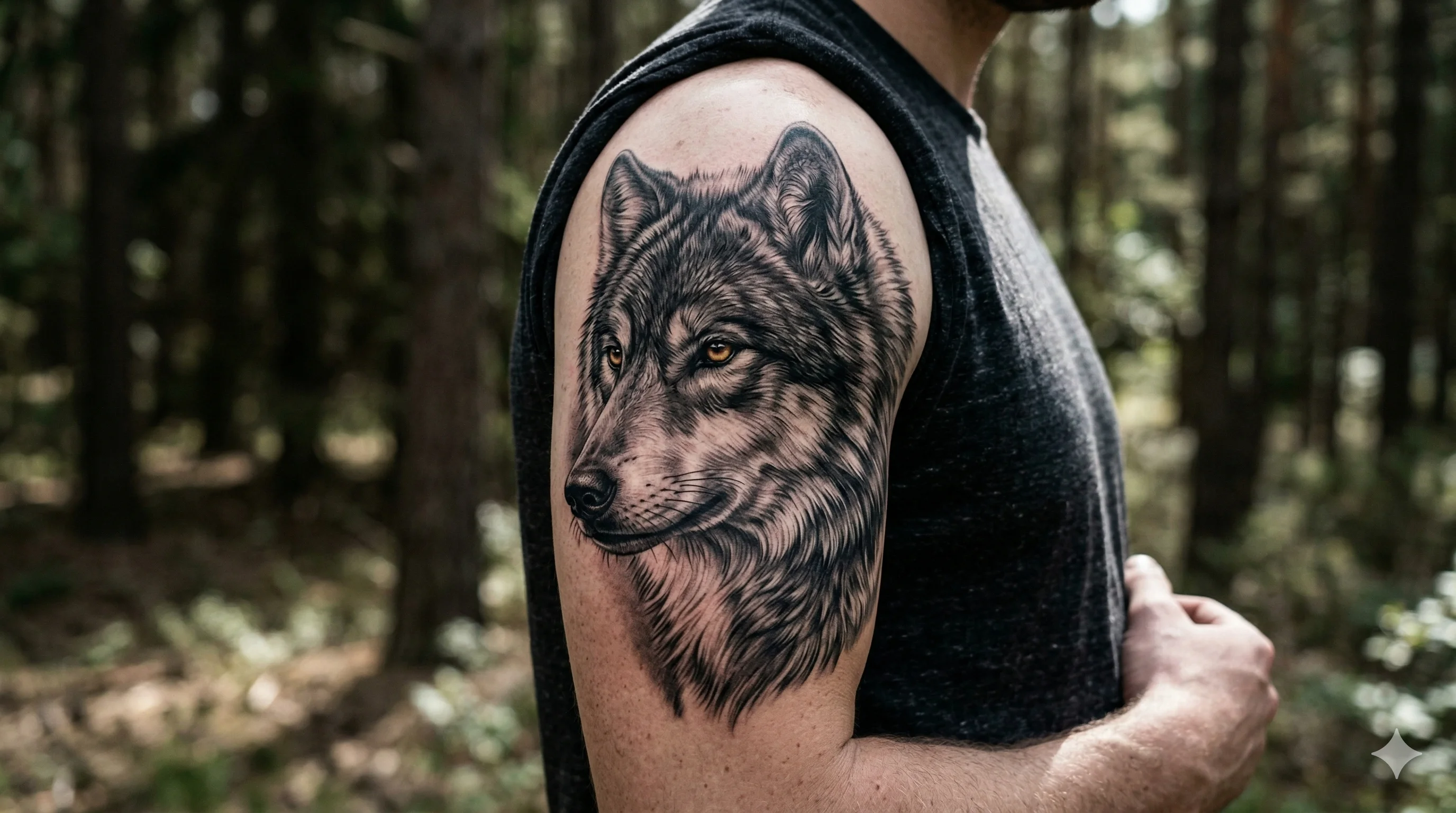
Realistic wolf tattoos attempt to capture the actual texture and depth of wolf fur, the specific expression in a wolf's eyes, and the three-dimensional quality of the animal's face. When executed well, a realistic wolf tattoo is extraordinary — the kind of piece that makes people stop and look closely.
What makes realistic wolf tattoos work:
- Extreme attention to fur texture — each strand of hair suggests depth
- Accurate eye rendering — a wolf's eyes are expressive and specific, not generic
- Precise shading that creates volume and form
- Usually works best in black and grey, though color realism exists
Realistic wolf is ideal for: large placements where detail can be preserved — full sleeve, chest piece, thigh, back. Attempting realistic detail in small formats usually produces muddy results as the tattoo ages.
Finding the right artist: Realism requires specific skills that not every artist has. Review portfolios specifically for realistic animal tattoos, particularly fur-intensive animals (wolves, bears, dogs). The technique for rendering fur is distinct from other realism skills.
Geometric Wolf Tattoos
Geometric wolf tattoos reduce the wolf to its essential lines and planes, using geometric shapes — triangles, polygons, tessellations — to construct the wolf's form. The result is distinctive, visually striking, and carries a different kind of symbolic weight than realistic rendering.
What makes geometric wolf tattoos work:
- Clean, precise linework — geometric tattoos live or die on line quality
- Meaningful contrast between geometric structure and organic wolf form
- Often combined with negative space (the wolf shape defined by what surrounds it)
- The geometry can be dense and complex or minimal and open
Geometric wolf is ideal for: forearm, calf, upper arm — placements where the design can be viewed as a whole. The geometric framework makes these pieces work well in medium sizes.
The symbolism shift: Geometric treatment often reads as more philosophical than emotional. The wolf in geometric form suggests structure, order, the laws underlying nature. If you want a wolf tattoo that feels thoughtful and conceptual rather than raw and visceral, geometric is worth exploring.
Fine Line Wolf Tattoos
Fine line wolf tattoos use extremely thin lines to create delicate, almost sketch-like renderings of wolves. This style has exploded in popularity since 2020 and shows no signs of slowing.
What makes fine line wolf tattoos work:
- Minimal lines that suggest the wolf without fully rendering it
- Often combined with small size — fine line wolf tattoos can be done at 2-3 inches
- Elegant and subtle — these don't announce themselves the way bold styles do
- Works particularly well in black and grey single needle
Fine line wolf is ideal for: inner forearm, wrist, collarbone, ankle, ribcage. The delicacy of the style suits more intimate placements.
Important caveat on aging: Fine line tattoos require more careful maintenance and age differently than bold styles. Single needle work can fade and spread over time. If longevity without touch-ups is a priority, discuss this with your artist before committing.
Blackwork Wolf Tattoos
Blackwork uses large fields of solid black ink, bold outlines, and high contrast to create powerful, graphic wolf designs. This is the opposite aesthetic extreme from fine line — where fine line whispers, blackwork declares.
What makes blackwork wolf tattoos work:
- Strong silhouettes that read immediately from a distance
- Bold graphic quality that ages extremely well
- Often incorporates negative space creatively
- Works beautifully with ornamental elements — mandalas, floral frames, geometric accents
Blackwork wolf is ideal for: people who want a statement piece, people who want longevity and easy maintenance, people drawn to the darker visual vocabulary of tattoo tradition.
Watercolor Wolf Tattoos
Watercolor wolf tattoos use loose, splashed color fields to create a painterly effect — as if the tattoo were made with watercolor paint rather than ink. The wolf design typically has a sketched or minimal linework base, with color washes around and through it.
What makes watercolor wolf tattoos work:
- Vibrant color that creates genuine visual impact
- Unique and distinctive — watercolor pieces are always recognizable as intentional artistic choices
- The looseness of the style suggests movement and fluidity
Important caveat: Watercolor tattoos are the style most affected by aging. The loose color washes can spread and lose definition over time, particularly without a strong linework base. The best watercolor wolf tattoos have sufficient structure to remain legible as they age. Discuss this specifically with your artist.
American Traditional Wolf Tattoos
American Traditional wolf tattoos use the classic vocabulary of traditional tattooing — bold black outlines, limited flat color palette (reds, yellows, greens, blues, blacks), simplified forms, and iconic imagery. The wolf in this style often has a bold, slightly stylized quality with heavy outlines.
What makes Traditional wolf tattoos work:
- Timeless quality — traditional tattoos are literally designed to look good for decades
- Clear iconographic impact — these read from a distance without ambiguity
- Deep roots in tattoo culture and history
- Pairs beautifully with other traditional flash elements
Traditional wolf is ideal for: people who love classic tattoo aesthetics, people who want a piece that will age gracefully without requiring touch-ups, people building a traditional sleeve or body suit.
Neo-Traditional Wolf Tattoos
Neo-Traditional takes the bold outlines and saturated palette of Traditional tattooing and adds detail, dimension, and complexity — larger color range, more sophisticated shading, more elaborate compositions. The wolf in Neo-Traditional style often has expressive eyes, detailed fur, and rich surrounding botanical or ornamental elements.
Neo-Traditional wolf is ideal for: people who love the graphic quality of Traditional but want more visual complexity and detail, people building elaborate themed sleeves.
Tribal and Cultural Wolf Tattoos
Indigenous-influenced wolf tattoos — Pacific Northwest formline, Haida, Tlingit, Maori, Celtic knotwork — carry their own visual languages and cultural meanings.
If you're drawn to these styles because of your own cultural heritage, they can be deeply meaningful connections to ancestry. If you're attracted to these styles from outside those cultures, it's worth understanding the specific visual language you're engaging with — and considering whether working with an artist from that tradition is appropriate.
Best Placements for Wolf Tattoos
Where you put a wolf tattoo significantly affects how the design reads and how the symbolism lands. Here are the primary placements and their characteristics.
Chest Wolf Tattoos
The chest is one of the most powerful placements for wolf tattoos, particularly realistic or blackwork pieces. The chest positions the wolf directly over the heart — which adds symbolic weight for loyalty, love, and protection meanings. Large wolf pieces on the chest (spanning across the pec, or centered on the sternum) create striking visual impact.
Best styles for chest: realism, blackwork, neo-traditional. Large-format pieces that need room to breathe.
Forearm Wolf Tattoos
The forearm is probably the most popular placement for wolf tattoos overall. It's highly visible, provides a good canvas for medium-sized pieces, and positions the tattoo where the wearer sees it regularly.
Inner forearm: More intimate, often used for smaller fine line or single needle pieces. Personal reminder energy.
Outer forearm: Bolder, more visible to others. Works for medium-sized realistic, geometric, or blackwork pieces.
Upper Arm / Sleeve Wolf Tattoos
The upper arm and full sleeve are classic placements for elaborate wolf compositions. A sleeve centered on a wolf can incorporate forest environments, other wildlife, Norse or Native American elements, moons, mountains — building a complete visual world around the central wolf subject.
Back Wolf Tattoos
The back provides the largest available canvas on the human body. A full-back or upper-back wolf piece can be extraordinarily detailed — the kind of realistic work that would be impossible at smaller scales. Back pieces are typically larger commitments (both in session time and cost) but create some of the most impressive tattoos possible.
Thigh Wolf Tattoos
The thigh offers significant canvas space with excellent visibility when desired and discretion when needed. Thigh wolf tattoos have gained significant popularity, particularly among women, because the placement suits both large realistic pieces and more delicate fine line work equally well.
Calf Wolf Tattoos
The calf provides a natural vertical canvas that works well for standing wolf designs — a wolf on a mountain, a wolf in a forest, a geometric wolf composed vertically. Calf placement is bold and visible without being as prominent as forearm or chest.
Neck Wolf Tattoos
Neck tattoos signal commitment — they're visible in virtually all professional contexts. Wolf tattoos on the neck (particularly the side or back of the neck) tend to be bold and graphic — blackwork, traditional, or simplified designs that read clearly at small scales.
Choosing the Right Artist
Wolf tattoos require different skills depending on the style you choose. Selecting the right artist is as important as selecting the design.
For realistic wolf tattoos: Find artists who specialize in black and grey realism specifically. Look for portfolio work with animals, particularly those with fur (dogs, bears, wolves). Rendering fur texture convincingly is a technical skill — not every talented artist has developed it specifically.
For geometric wolf tattoos: Look for precise, clean linework. Geometric tattoos rely entirely on line quality and measurement accuracy. Wobbly lines in geometric work are immediately visible and very difficult to fix.
For fine line wolf tattoos: Seek artists who specifically list single needle or fine line work. This is a precise technique that requires specific equipment and skill.
For traditional and neo-traditional: Look for artists with genuine portfolios in the style, not artists who are attempting it occasionally. Traditional tattooing has specific conventions and a specific vocabulary — someone who lives in the style will execute it better than someone who visits it.
Questions to ask any artist:
- Can I see examples of wolf or animal tattoos specifically in my desired style?
- How does this style age, and what maintenance should I expect?
- What size and placement do you recommend for my design?
- How do you approach the fur/eye rendering in wolves specifically?
Wolf Tattoo Designs: Key Elements and Combinations
The wolf is rarely tattooed in isolation. The most compelling wolf tattoo compositions combine the wolf with elements that deepen or contextualize the symbolism.
Wolf and Moon
The wolf-and-moon combination is one of the most iconic in tattooing, and for good reason — the image captures something primal and true. Wolves howl at the moon (actually as a form of communication, not specifically because of the moon, but the image predates that correction). The combination of wolf and moon suggests instinct, wildness, cycles, the untameable.
Design variations: Full moon behind a howling wolf silhouette (classic, powerful); crescent moon in a fine line composition (elegant, more intimate); geometric wolf with moon phases above (conceptual, contemporary).
Wolf and Forest
A wolf emerging from or moving through a forest environment brings in additional symbolism: the forest represents the wilderness, the unconscious, the space outside civilization. A wolf in the forest is a wolf in its element — confident, purposeful, at home.
Wolf and Mountain
Mountains add themes of challenge, aspiration, and permanence to wolf imagery. A wolf against a mountain landscape suits people who connect wolf energy with their own experiences of difficulty and endurance.
Wolf and Geometric/Sacred Geometry
Combining wolf imagery with geometric patterns, mandalas, or sacred geometry creates a more philosophical composition. The juxtaposition of the organic wolf and the mathematical geometry suggests the relationship between instinct and structure, nature and order.
Wolf Pack
Multiple wolves in a single tattoo immediately shift the symbolic emphasis to family and loyalty. Pack compositions work well as sleeves (wolves arranged around the arm) or as back pieces (pack moving through a landscape).
Wolf Skull
The wolf skull combines the living wolf with the skull's memento mori symbolism. This composition suits people drawn to darker aesthetic vocabularies and to themes of mortality, transformation, and the passage from life.
How to Use AI Tools to Design Your Wolf Tattoo
This is where modern tattoo research has genuinely changed. Before sitting with an artist, you can now generate AI images of wolf tattoo concepts that are specific to your vision — not generic clipart, but actual tattoo design concepts in specific styles.
What AI tattoo generators can do for you:
Explore style variations quickly. Not sure if you want realistic or geometric? Generate both for the same wolf concept and compare how they feel. This saves you hours of scrolling through Instagram and Pinterest.
Test placement concepts. Some AI tools allow you to place generated designs on body reference images, giving you a sense of scale and composition before committing.
Generate starting points for artist conversations. Many people find it easier to walk into a consultation with AI-generated references than with vague verbal descriptions. "Something like this, but with the moon closer and the fur more detailed" is a much more productive starting point than describing everything from scratch.
Refine specific elements. You can iterate — "more aggressive expression," "add a forest background," "geometric version of this realistic design" — until you have something that captures your vision.
The AI image is not your final tattoo. It's a communication tool between your imagination and your artist's skill. The artist will bring their technical expertise, their knowledge of what translates to skin, and their own creative input to the final design. But starting that conversation with a strong visual reference is dramatically better than starting without one.
Wolf Tattoo Frequently Asked Questions
Are wolf tattoos only for men?
No. Wolf tattoos are genuinely popular across all genders. The symbolism — loyalty, independence, strength, intuition — resonates broadly. The style choice often varies: fine line and watercolor wolf tattoos skew toward women statistically, while bold blackwork and realism are more evenly distributed. The design itself is neutral.
Do wolf tattoos have negative meanings?
In some Western cultural contexts, wolves were historically associated with danger, deception (the "big bad wolf"), and threat to civilization. A few people will read a wolf tattoo with that lens. Most people in 2025 associate wolf tattoos with the positive symbolism described throughout this guide. This is not a symbol that carries significant negative cultural baggage.
How much does a wolf tattoo cost?
Cost varies enormously by size, style, artist reputation, and location. A rough framework:
- Small fine line wolf (2-3 inches): $150-$300
- Medium realistic piece (6-8 inches): $400-$800
- Large chest or thigh piece: $800-$2,000
- Full sleeve centered on wolf: $3,000-$8,000+
These are approximations. Rates vary significantly by city and artist. Established artists with strong portfolios charge more — and typically deliver better results.
How long does a wolf tattoo take?
- Small/simple designs: 1-2 hours
- Medium realistic pieces: 3-6 hours
- Large or elaborate pieces: Multiple sessions, potentially 10-20+ hours total
What should I avoid with wolf tattoos?
- Avoid "wolf howling at moon" clipart designs — they exist everywhere and age poorly
- Avoid rushing the artist selection process
- Avoid placing complex realistic work in areas that distort significantly with weight change or age
- Avoid assuming all wolf tattoo artists are equally qualified — style specialization matters
Can I combine a wolf with other animals?
Yes, and it can be extremely effective. Wolf and raven combinations appear in Norse mythology. Wolf and bear suggest primal strength. Wolf with a deer or rabbit introduces predator-prey dynamics. These combinations add narrative complexity to the tattoo.
Final Thoughts
A wolf tattoo, done well, is one of the most compelling pieces in tattooing. The symbolism is genuine, the versatility is extraordinary, and the visual impact — whether you choose delicate fine line or bold blackwork, realistic portrait or geometric abstraction — is consistently strong.
The key decisions: style first (this determines your artist shortlist), then placement (this determines size constraints), then specific design elements (this is where you can bring in personal meaning through specific combinations and details).
If you're not sure where to start, use an AI tattoo generator to explore concepts before committing to a consultation. Test realistic vs. geometric, lone wolf vs. pack, with moon vs. with forest. The more clearly you can see your vision, the better conversation you'll have with the artist who'll bring it to life.
The wolf is one of those tattoo subjects where the effort you put into the research pays off directly in the final piece. Take the time to get it right.