
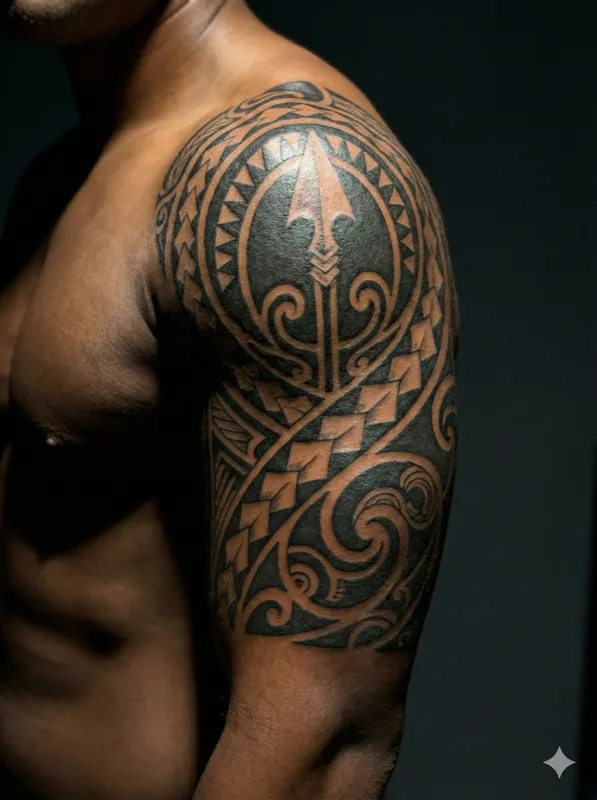
Few tattoo styles carry the weight of history that tribal tattoos do. Long before tattooing became a mainstream art form in the West, indigenous cultures across the Pacific, the Americas, Africa, and Europe were using permanent body markings to communicate identity, status, spiritual connection, and belonging. A Maori warrior's moko told his entire lineage. A Polynesian chief's pe'a marked his rank and readiness. A Celtic tribal band encoded cosmological beliefs into interlocking knotwork.
Today, tribal tattoos are among the most requested styles in studios worldwide — loved for their bold aesthetics, graphic power, and deep roots. But they're also among the most misunderstood. This guide covers everything you need to know: the major traditions, what the patterns mean, how to approach the style respectfully, and how to design tribal ink that feels authentic to you.
What Defines a Tribal Tattoo?
"Tribal" is a broad umbrella term that encompasses dozens of distinct cultural tattooing traditions from around the world. Despite their differences, most tribal styles share common visual characteristics:
- Bold, solid black ink — no gradients, no color (in traditional forms)
- Geometric and organic interlocking patterns — curves, spirals, spearheads, chevrons, dots
- Strong negative space — the untattooed skin is as deliberate as the ink
- Placement that follows body contours — designs flow with muscle and bone structure
- Symbolic content — every element carries meaning in authentic traditions
In contemporary tattooing, "tribal" often refers to the visual aesthetic rather than authentic cultural practice — bold black linework with flowing, interlocking geometric forms. This modern interpretation draws from multiple traditions simultaneously and is stylistically distinct from cultural tribal tattooing.
The Major Tribal Traditions
Polynesian Tattoo
Polynesian tattooing is arguably the most globally recognized tribal style. It encompasses several related but distinct subtraditions across the Pacific:
Maori (New Zealand) The Maori tradition of tā moko is one of the most distinctive tattooing practices in human history. Unlike most tattoo styles that sit on the skin, traditional moko was carved into the skin using chisels, creating grooves that were filled with pigment. The result: designs that are literally sculpted into the face and body.
Facial moko (moko kauae for women, full-face moko for men of high rank) encode genealogy, tribal affiliation, and personal identity. The spirals (koru), parallel lines, and interlocking curves each carry specific meanings within a complex symbolic language. No two traditional moko are identical — each is as unique as a fingerprint.
Modern Maori tattooing typically uses needles rather than chisels, but the symbolic vocabulary remains intact. Many Maori artists are highly protective of this tradition and will only create authentic moko for Maori individuals — for others, they create kirituhi ("written on skin"), designs inspired by Maori aesthetics without the genealogical encoding.
Samoan The Samoan pe'a (for men) and malu (for women) are full-body tattoos that represent one of the most demanding tattooing rituals in the world. The pe'a covers from the waist to the knees in dense, intricate geometric patterns. It is applied over weeks using traditional tools — a comb-like instrument (au) made from boar tusk, attached to a handle — tapped into the skin.
Receiving the pe'a is a rite of passage requiring extraordinary physical and mental endurance. The patterns include nifo pe'a (bat teeth), asoloa (straight lines), and fusi (waistband) elements. Traditional Samoan tattooing is practiced by specialist tattooists called tufuga ta tatau who inherit the knowledge across generations.
Hawaiian Ancient Hawaiian kakau tattoos served both protective and devotional functions. Common motifs included niho mano (shark teeth) believed to confer the shark's protective power, aumakua (ancestral spirits) encoded in geometric forms, and patterns marking important life events. Hawaiian tattooing nearly disappeared after colonial contact but is currently experiencing a renaissance, with contemporary Hawaiian artists reviving traditional forms and teaching their cultural significance.
Marquesas and Tahitian Marquesas Islands tattooing was among the most comprehensive and elaborate in the Pacific, covering the entire body in interlocking geometric designs. Characteristic motifs include tiki faces (stylized human faces), centipede patterns, and complex geometric grids. Tahitian tatau — the word that gave us "tattoo" in English (Captain Cook's crew borrowed it phonetically in 1769) — features similar geometric vocabulary with distinctive local variations.
Celtic Tribal Tattoo
Celtic tattoo traditions draw from the art of ancient Celtic peoples of Western Europe, particularly Ireland, Scotland, Wales, and Brittany. Celtic art is characterized by:
- Knotwork — endless interlacing patterns with no beginning or end, symbolizing eternity and interconnection
- Spirals — triskele (triple spiral), single spirals, and S-curves representing life cycles, time, and spiritual growth
- Zoomorphic forms — animals rendered in abstract, interlacing styles (the Book of Kells is a key visual reference)
- Geometric borders and fills — step patterns, key patterns, and fretwork
Whether ancient Celts actually tattooed themselves remains historically debated, but the visual vocabulary of Celtic art translates powerfully into tattoo form. Celtic tribal tattoos are deeply popular in communities with Irish, Scottish, and Welsh heritage, often worn as expressions of cultural identity.
Native American Tribal Tattoo
This category requires significant care and nuance. Dozens of distinct nations across North America had their own tattooing traditions, each with specific meanings within their cultural contexts. Haida formline art (from the Pacific Northwest coast) features bold black ovoid shapes and U-forms depicting clan animals with extraordinary graphic power. Inuit kakiniit tattooing uses thin lines to mark gender, life stages, and spiritual status. Plains nations used tattoos to mark coups and battle achievements.
Important note: Many Native American communities consider their traditional tattoo designs sacred and tied to specific ceremonial and cultural contexts. Wearing these designs without that cultural connection is viewed by many communities as disrespectful. If you're drawn to specific Native American designs, research the tradition carefully and consider consulting with artists from that nation before proceeding.
Filipino Tribal Tattoo (Batok)
Kalinga and Visayan tattooing traditions in the Philippines are among Asia's oldest and most visually striking. The Kalinga people of the Mountain Province have been tattooing continuously for centuries. Women traditionally received tattoos marking beauty and femininity; men received tattoos marking headhunting achievements.
The late Whang-od Oggay (born circa 1917), considered the last traditional Kalinga mambabatok (tattoo practitioner), became an international icon before her death in 2024 at approximately 106 years old. Her geometric batok designs — applied with thorns and hand-tapping technique — drew pilgrims from around the world to her village in the Cordilleras.
Borneo Dayak Tattooing
Indigenous Dayak peoples of Borneo developed sophisticated tattooing traditions in which specific designs denote social status, spiritual protection, and regional identity. The Iban pantang designs and Kenyah/Kayan tedak motifs feature complex curvilinear patterns with zoomorphic elements (hornbills, dogs, and supernatural beings). Traditional Dayak tattooing is experiencing revival among younger generations who see it as a form of cultural reclamation.
Tribal Tattoo Design Elements
Across traditions, certain geometric elements appear repeatedly. Understanding their general symbolic weight helps you make more intentional design choices:
| Element | Common Symbolism |
|---|---|
| Spirals / Koru | Life, growth, new beginnings (especially Maori) |
| Spearheads / Niho | Warrior strength, protection, overcoming obstacles |
| Chevrons / V-shapes | Movement, direction, journey |
| Solid triangles | Teeth — power, status, authority |
| Interlocking knots | Eternity, unity, interconnection (Celtic) |
| Ocean waves | Journey, adaptability, the sea as life source |
| Tiki face | Ancestral protection, spiritual guardian (Polynesian) |
| Turtle / Honu | Longevity, navigation, family, home |
| Manta ray | Freedom, grace, connection to the ocean |
| Shark elements | Protection, adaptability, strength |
| Sun motifs | Leadership, eternity, vitality |
Best Placement for Tribal Tattoos
Tribal designs are specifically engineered to follow the body's natural geometry. Placement matters enormously both aesthetically and, in traditional contexts, symbolically.
Upper arm and shoulder The most classic tribal placement. The curved surfaces of the deltoid and bicep allow large geometric designs to wrap naturally. Traditional upper arm pieces often extend into sleeve configurations that flow down the forearm.
Chest and pectoral Large chest pieces can be deeply impactful, particularly designs that frame the collarbone and flow across the sternum. Polynesian chest pieces traditionally connect to upper arm pieces as part of comprehensive body coverage.
Back and spine The back offers the largest canvas for comprehensive tribal work. Spinal designs that flow vertically are particularly popular, as are full-back pieces in the style of Pacific traditions.
Calf and lower leg The calf's rounded musculature works beautifully with wrap-around tribal patterns. The Samoan malu (women's traditional tattoo) focuses heavily on the thighs and back of the knees.
Forearm and wrist Bold tribal armband designs work well on the forearm, following the limb's cylindrical form. Wrist designs can be more delicate or serve as the anchor for larger sleeve work.
Thigh The thigh offers a substantial canvas for large tribal pieces that wrap around the leg. Less visible than arms in everyday settings, making it a popular choice for those who want large traditional work they can reveal or conceal.
Face Traditional in Maori, Hawaiian, and some other traditions. In contemporary tattooing, facial tribal pieces are bold statements that require deep consideration given their permanent visibility.
How to Find a Tribal Tattoo Artist
Not all tattoo artists are equipped to execute tribal work well. Here's what to look for:
Specialization matters. Look for artists who specifically showcase tribal work in their portfolio, not generalist artists who do it occasionally. Tribal tattooing demands consistency, confidence in linework, and understanding of how geometric forms wrap around the body.
Clean, consistent linework. Tribal tattoos live and die by linework precision. Wobbly lines, inconsistent line weights, and poorly filled solid sections look amateurish and age poorly. Examine portfolio images critically.
Cultural knowledge. If you want work in a specific tradition (Polynesian, Celtic, etc.), an artist who understands the symbolic vocabulary will create more authentic work than one who's simply copying visual references. Many Polynesian artists actively consult with clients about their life story and ancestry to create personalized designs.
Consider cultural practitioners. For traditions like Maori, Samoan, or Hawaiian tattooing, seek out artists who are members of that culture or who have specifically trained in the tradition. The cultural transmission adds layers of meaning and ensures the designs are used respectfully.
Healing and touch-up experience. Large black fills can be tricky to heal evenly and may require touch-ups. Ask artists about their healing recommendations and touch-up policies.
Cultural Appropriation vs. Cultural Appreciation
This is one of the most important conversations in tribal tattooing, and it doesn't have a simple answer.
The concern: Sacred symbols from living cultures — particularly Maori moko, Samoan pe'a, Native American ceremonial designs — carry specific cultural meanings and are tied to identities they don't apply to in outsiders. Wearing them without that context can feel disrespectful to communities that have sometimes had their cultures marginalized or appropriated.
The nuance: "Tribal-inspired" or "neo-tribal" designs draw aesthetic vocabulary from multiple traditions to create original work in the style rather than copying specific sacred symbols. Many Polynesian and Maori artists themselves create work for clients of all backgrounds using the design language without encoding specific genealogical or sacred content.
Practical guidance:
- Research the specific tradition before getting tattooed
- Consult with an artist from that culture if possible
- Avoid copying specific sacred or ceremonial symbols (particularly Maori moko, Lakota ceremonial designs, or other symbols with deeply specific cultural status)
- Understand that "inspired by" and "appropriating specific sacred symbols" are different things
- If an artist from a culture tells you a design isn't appropriate for outsiders, respect that
The conversation around cultural appreciation vs. appropriation in tattooing is ongoing. Approaching it with curiosity, humility, and willingness to learn is always the right move.
Modern Tribal and Neo-Tribal Styles
Contemporary tattoo artists have developed several approaches to tribal aesthetics that draw from traditional visual languages while creating new forms:
Neo-tribal Combines graphic elements from multiple tribal traditions into original compositions. Often bolder and more abstract than any single source tradition. Artists like Filip Leu and Horiyoshi III (though they have their own distinct traditions) helped establish the internationalization of tribal aesthetics.
Blackwork tribal Overlaps significantly with the broader blackwork movement — large-scale black ink pieces that use geometric and organic forms. Some blackwork artists work in specifically tribal idioms; others create original geometric compositions that carry tribal visual weight without specific cultural reference.
Dotwork tribal Some artists incorporate stippling and dotwork texture into tribal-inspired designs, creating gradient effects and tonal variation within the traditionally solid-black aesthetic.
Colored tribal (controversial) Adding color to tribal designs is a contemporary departure from almost all traditional tribal tattooing traditions, which are exclusively black. Some contemporary artists do work in colored tribal styles. Whether this respects or dilutes the tradition is a matter of ongoing debate in the tattoo community.
Designing Your Tribal Tattoo with AI
The design phase of a tribal tattoo — figuring out what elements to include, how they might wrap around your specific body placement, what overall composition might work — used to require multiple consultations and hand-drawn sketches before you could really visualize anything.
AI tattoo generators have dramatically changed this. You can now:
Explore styles quickly. Type in "Polynesian tribal armband," "Celtic knotwork sleeve," or "Maori-inspired back piece" and get instant visual references to understand what resonates with you before you commit to anything.
Refine design direction. Use AI-generated images as conversation starters with your tattoo artist rather than blank-page consultations. Showing an artist "something like this, but wrapping around the outside of the arm more" saves time and produces better results.
Mix and match elements. AI tools let you explore hybrid approaches — what does a piece that combines Polynesian spearheads with Celtic knotwork actually look like? You can see it before you decide whether that's what you want.
Placement visualization. Some AI tools allow you to place design concepts on body reference images, giving a rough sense of how a piece might feel at your chosen placement.
Important caveat: AI-generated tribal designs should be treated as concept references, not finished tattoo designs. They often contain compositional inconsistencies or elements that wouldn't translate well to actual tattooing. Bring AI-generated concepts to a skilled tribal artist and let them refine and execute the design properly. The AI helps you find direction; the human artist makes it real.
Tribal Tattoo Aftercare
Tribal tattoos — particularly those with large solid black fills — require careful healing attention.
Heavy black fills need extra moisture. Dense black areas can dry out and crack during healing if under-moisturized, potentially causing the ink to heal unevenly or with gaps. Apply aftercare ointment or lotion diligently.
Avoid sun exposure during healing. All tattoos need sun protection while healing, but large black pieces are particularly vulnerable — direct sun can fade and distort the healing ink significantly.
Be prepared for potential touch-ups. Large black fills sometimes heal with light spots or patches where the ink didn't settle evenly. This is normal. Most tribal artists include a free touch-up session in their pricing. Wait until the tattoo is fully healed (3-4 months) before assessing and touching up.
Long-term sun protection. Black tribal tattoos can remain crisp for decades with proper sun protection. Without it, they fade, blur, and lose the sharp edge definition that makes them visually powerful. Sunscreen on healed tattoos during regular sun exposure is the single most important thing you can do for longevity.
Moisturize consistently. Large black areas can look dull and ashy on dry skin. A good daily moisturizer keeps tribal tattoos looking bold and vibrant long-term.
FAQ
Are tribal tattoos still popular in 2026? Yes — tribal remains one of the most consistently popular tattoo styles globally. While trends shift, the bold aesthetic and deep cultural associations of tribal work give it enduring appeal that fashion-driven styles don't have.
Do tribal tattoos hurt more than other styles? Large areas of solid black filling do tend to be more intense than lighter linework tattoos, since the artist must pack ink densely to achieve full coverage. Multiple passes over the same area are common. That said, pain varies enormously by placement and individual tolerance.
How long does a large tribal piece take? It depends heavily on scale. A small tribal armband might take 2-3 hours. A full sleeve in Polynesian style can take 20-40+ hours across multiple sessions. A back piece could run 40-80 hours. Discuss time estimates with your artist before beginning.
Can I add color to a tribal tattoo? Technically yes, but almost all traditional tribal aesthetics are black-only. Adding color significantly changes the visual character of the work and departs from nearly all authentic tribal traditions. If you want color, discuss it specifically with your artist and make sure they have portfolio examples of colored tribal work they're comfortable executing.
Will my tribal tattoo age well? Bold, solid black tribal tattoos age exceptionally well compared to detailed fine-line work or color tattoos. The bold lines resist the blurring that affects fine linework, and black ink fades more slowly than color. With consistent sun protection and moisturizing, a well-executed tribal piece should remain striking for decades.
Should I get a tribal tattoo if I have no connection to the culture? It depends on the specific design. Broadly inspired "neo-tribal" or "Polynesian-style" work created by an artist who understands the visual language is different from copying a specific sacred symbol or style marker. Research the tradition, consult with artists from that culture when possible, and approach the process with genuine curiosity about the designs' meanings.
Tribal tattooing connects you to one of humanity's oldest artistic and spiritual practices. Whether you're drawn to the flowing curves of Polynesian design, the interlocking geometry of Celtic knotwork, or the bold graphic power of modern neo-tribal work, there's a tribal tradition that speaks to something primal in the way humans have always used marks on skin to say: I was here. This is who I am. This is what I believe.
Use AI tools to explore your direction, find a skilled artist who specializes in the tradition you're drawn to, and take the time to understand what the patterns mean. A tribal tattoo earned through genuine engagement with its source is something else entirely from one picked off a flash sheet.
Ready to explore tribal tattoo designs? Our AI tattoo generator lets you visualize Polynesian, Celtic, Maori-inspired, and neo-tribal concepts instantly — find your direction before you ever walk into a studio.