
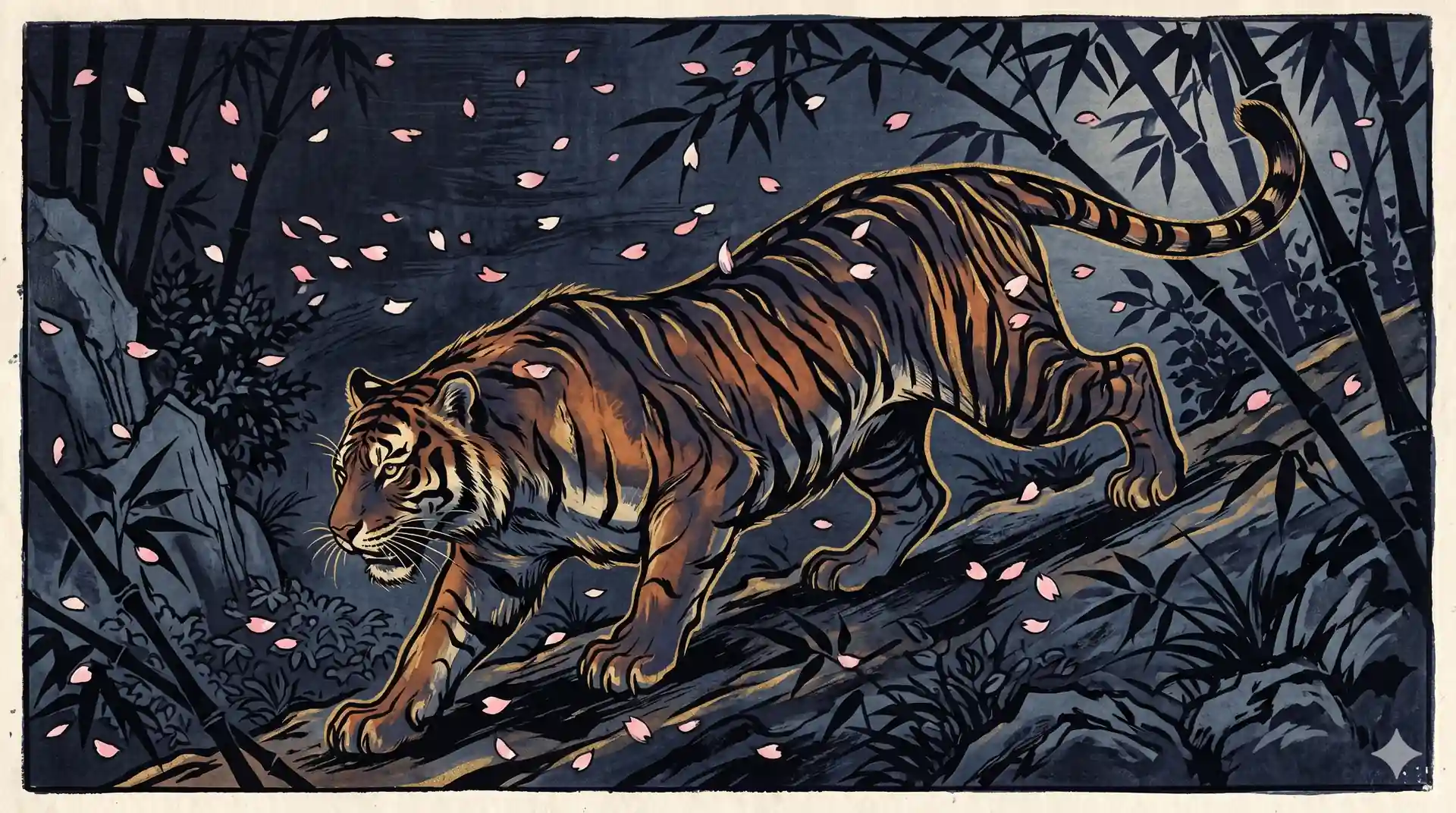
There's a reason tiger tattoos have dominated tattoo parlor walls for over a century. The tiger doesn't ask for your attention — it commands it. That combination of primal power, fluid grace, and an almost regal indifference to lesser threats has made the tiger one of the most requested tattoo subjects on every continent where tattoo culture exists. And it shows no signs of slowing down.
Whether you're drawn to the explosive drama of a roaring Japanese tiger wrapped in waves and cherry blossoms, the quiet menace of a realistic big cat watching from the shadows, or a minimalist geometric form that captures the essence of the animal in a dozen clean lines, tiger tattoos offer more creative range than almost any other subject. This guide covers everything you need: symbolism, cultural meanings, every major style, the best placements for your body, and how to use AI to design the perfect tiger tattoo before you ever sit in a chair.
What Does a Tiger Tattoo Mean?
Tiger tattoo symbolism is rich, consistent across cultures, and overwhelmingly positive — though it carries an edge that gentler subjects lack. These are not soft meanings.
The core meanings most people associate with tiger tattoos:
- Strength and raw power — The tiger is the largest cat on Earth, capable of bringing down prey many times its own weight. A tiger tattoo worn as a strength symbol isn't metaphorical; it's a direct claim.
- Courage and fearlessness — Tigers hunt alone, at night, often against much larger prey. They don't wait for backup. This makes the tiger a near-universal symbol of individual courage.
- Protection — In multiple Asian traditions, the tiger acts as a guardian figure. Temple gates, family crests, and warrior armor all employed tiger imagery to ward off evil and protect what mattered.
- Freedom and independence — Tigers don't form packs or herds. A tiger tattoo can honor the person who lives on their own terms.
- Passion and intensity — The tiger's focused, explosive energy has made it a symbol of desire and passion in many cultures, particularly in relation to fire and the sun.
- Balance of beauty and danger — No other apex predator is quite as beautiful as a tiger. That paradox — something stunning that can also kill you — resonates deeply with people who contain similar contradictions.
Tiger Tattoo Symbolism Across Cultures
Japanese tradition (Irezumi): In Japanese tattooing, the tiger is one of the four sacred animals (along with the dragon, phoenix, and tortoise). It rules the earth, the north, and autumn. Tiger and dragon together represent the balance of opposing forces — earth and heaven, feminine and masculine, yin and yang. Japanese tigers are almost always depicted in dynamic motion, surrounded by wind, waves, maple leaves, or chrysanthemums.
Chinese tradition: The white tiger (Bai Hu) is one of the Four Symbols of Chinese astrology, governing the west and autumn. It symbolizes military might, courage in battle, and protection against evil. In feng shui, the white tiger guards the home from the right side. Tiger amulets and imagery have been worn for protection for thousands of years.
Hindu and South Asian tradition: The tiger is the vahana (vehicle) of the goddess Durga, representing the untamed natural power she channels in battle. Bengali traditions, particularly around the Sundarbans, imbue the tiger with almost supernatural significance as a guardian of the forest.
Western tradition: In American traditional and neo-traditional tattooing, the tiger represents ferocity and strength without the cultural layering of Eastern traditions. It's often depicted roaring, in profile, surrounded by flames or tropical foliage — a pure statement of power.
Tiger Tattoo Styles: Every Major Approach
Japanese Irezumi Tiger
The most iconic tiger tattoo style in the world. Japanese Irezumi tigers are bold, stylized, and deeply compositional — they're designed to flow with the body rather than sit on it. Key characteristics: flat perspective, heavy black outlines, decorative background elements (waves, clouds, peonies, maple leaves, wind bars), and a characteristic "wind in the fur" texture that Irezumi masters render with extraordinary detail.
A full Japanese tiger sleeve or back piece is one of the most commanding tattoos a person can wear. Even smaller Japanese tiger tattoos — a shoulder cap, an outer thigh piece — carry the full visual weight of the tradition.
Realism / Photorealism
Photorealistic tiger tattoos have become one of the defining categories of contemporary tattooing. When executed by a skilled artist working in black-and-grey or full color, a realistic tiger can achieve a level of detail — individual whiskers, the depth of the eyes, the texture of fur varying across the face — that stops people cold.
This style demands an artist who specializes in realism. The difference between a mediocre realistic tiger and an exceptional one is enormous, and it shows.
Neo-Traditional
Neo-traditional tiger tattoos blend the bold outlines and saturated colors of American traditional tattooing with more sophisticated illustration techniques, shading, and a wider color palette. They're expressive rather than documentary — the tiger is recognizable but heightened, stylized with exaggerated features, and often surrounded by decorative botanical or ornamental elements.
This is one of the most versatile styles for tiger tattoos: bold enough to read from a distance, detailed enough to reward close inspection.
Geometric and Blackwork
Geometric tiger tattoos reduce the animal to its structural essence — angular planes, interlocking shapes, negative space — while retaining the unmistakable silhouette. These work especially well as standalone pieces on the forearm, chest, or thigh.
Blackwork tiger tattoos — solid black shapes with minimal linework — carry enormous visual presence for their simplicity. A tiger head rendered in pure blackwork can be more striking than a detailed full-color piece.
Minimalist
Minimalist tiger tattoos use single lines, simple shapes, or clean outlines to suggest the tiger without rendering it in full. These are ideal for people who want the meaning without the commitment to a large piece, and they age particularly well.
Popular minimalist approaches: a single-line tiger face, a small tiger silhouette, a geometric tiger stamp.
Watercolor
Watercolor tiger tattoos simulate the wash and flow of watercolor painting, with color bleeding beyond the lines and intentional ink "splashes" as part of the composition. The contrast between the controlled structure of the tiger and the expressive freedom of the watercolor background can be visually spectacular.
Note: watercolor tattoos require an artist skilled in the style and regular touch-ups as the pigment fades faster than traditional ink.
Trash Polka and Illustrative
For those who want something aggressive and visually complex, trash polka combines black-and-red realism with abstract elements, smears, and typographic components. A tiger in this style becomes almost aggressive — confrontational in a way that softer styles aren't.
Tiger Tattoo Designs: Ideas and Variations
Roaring tiger: The most direct expression of power and aggression. A full-face roaring tiger is a classic for a reason — the composition is inherently striking, and it works in virtually every style from Japanese to photorealistic.
Prowling / stalking tiger: A full-body tiger in a low, hunting posture conveys menace and focus. This composition works particularly well as a sleeve or back piece where the body has room to stretch out.
Tiger and dragon: One of the most enduring tattoo combinations in existence. In Japanese tradition, this pairing represents the balance of opposing forces. The tiger dominates the earth; the dragon commands the heavens. Together they represent completeness.
Tiger with flowers: Tigers surrounded by peonies, chrysanthemums, cherry blossoms, or tropical flowers soften the animal's aggression without diminishing it. This is one of the most requested combinations in Japanese tattooing, and for good reason — the contrast between soft botanicals and raw power creates extraordinary visual tension.
White tiger: The mythological white tiger, drawn in silver, white, and grey tones, carries the specific symbolism of the Chinese celestial guardian. These are among the most dramatic tiger tattoos when done well.
Tiger and moon: Night imagery combined with a tiger's nocturnal nature. A tiger beneath a full moon, or a tiger face framed by crescent shapes, works beautifully in both realism and decorative styles.
Tiger stripes as design element: Some designs use the tiger's distinctive stripe pattern as the primary visual element — wrapping around a limb, flowing across the chest, or abstracting into pure pattern.
Tiger eyes: A close-up of a tiger's eyes, rendered in photorealistic detail, can be profoundly striking as a chest or back piece. The intensity of the tiger's gaze, captured at that scale, is difficult to ignore.
Best Placements for Tiger Tattoos
Full Back
The back is the single best canvas for an ambitious tiger tattoo. A full-back Japanese tiger — the animal in motion against a background of waves, clouds, and maple leaves — is among the most spectacular tattoos achievable. The back provides the scale that a complex composition demands, and tiger tattoos here rarely look crowded.
Full Sleeve
Sleeve tattoos are ideal for Japanese-style tigers, where the design can wrap around the arm, flow from shoulder to wrist, and incorporate the natural curves of the forearm and upper arm as compositional elements. A tiger sleeve is a multi-session commitment, but the result is a complete, unified piece that works from every angle.
Chest
A tiger chest tattoo — particularly a centered roaring tiger face or a tiger that extends from the chest across the shoulder — is powerful and personal. It sits close to the body's center and is revealed or concealed easily. Many people choose this placement for tigers with personal protective significance.
Thigh
The outer thigh is one of the best placements for mid-sized tiger tattoos. It offers a wide, flat canvas with minimal distortion, ages well, and accommodates both horizontal (stalking) and vertical (sitting) compositions. Pain levels are generally manageable.
Forearm
A forearm tiger — particularly a prowling tiger on the outer forearm or a Japanese tiger wrapping from the inner to outer surface — works well as a standalone piece or as part of a larger sleeve build.
Ribs / Side
The ribcage is a challenging placement (high pain, complex surface) but rewards commitment. A tiger on the ribs and side can stretch along the torso in a way that few other placements allow, and the movement of the body animates the design.
Calf
The calf is an underutilized but excellent placement for tiger tattoos, particularly vertical compositions. A tiger climbing or descending the calf, rendered in Japanese or neo-traditional style, works beautifully with the natural shape of the muscle.
How AI Is Transforming Tiger Tattoo Design
The traditional design process — describing your vision to an artist, waiting days or weeks for sketches, going through rounds of revisions — has served tattoo culture for decades. But it has a fundamental limitation: most people can't accurately describe what they want, and most artists can't read minds.
AI tattoo generators have changed this equation. You can now generate dozens of tiger tattoo concepts in minutes, iterating on style, composition, placement, and detail level until you have an image that matches the vision in your head. Then you bring that image to your artist as a reference.
What AI tattoo generators are good at:
- Generating style variations quickly (Japanese vs. realism vs. geometric, all of the same tiger concept)
- Exploring combinations that are hard to describe in words ("a tiger with peonies but less aggressive, more like it's sleeping")
- Creating placement visualizations that show how a piece might look on a specific body area
- Producing clean line-work references that tattoo artists can work from directly
The limitation: AI-generated images are starting points, not finished tattoo designs. A skilled tattoo artist will adapt any AI reference to account for how ink behaves on skin, the specific curvature of your body, and how the piece will age over time. Use AI to find your direction; trust your artist to get you there.
Choosing the Right Artist for Your Tiger Tattoo
Style matching matters enormously with tiger tattoos. An artist who excels at photorealism may produce mediocre Japanese-style work, and vice versa. Before booking, review portfolios specifically for:
- Tigers or other large cats (big cats share similar technical challenges)
- Examples of the specific style you want
- Healed photos — how does the work look after 2+ years?
For a Japanese tiger, find an artist with demonstrated Irezumi experience. For photorealistic, find someone whose realistic animal work is indistinguishable from photographs. Don't compromise on artist selection for a piece you'll wear for life.
Tiger Tattoo Aftercare
Tiger tattoos, particularly large or heavily detailed pieces, require diligent aftercare:
- Keep the fresh tattoo covered and moist for the first 24-48 hours
- Wash gently with fragrance-free soap 2-3 times daily
- Apply a thin layer of unscented moisturizer (Aquaphor, CeraVe) when dry
- Avoid sun exposure during healing — UV radiation is the primary cause of tattoo fading
- No swimming in pools, lakes, or the ocean until fully healed (2-4 weeks)
- Touch-ups are normal for complex pieces; schedule a follow-up after 3 months
FAQ: Tiger Tattoos
How long does a tiger tattoo take? Depends entirely on scale and complexity. A small minimalist tiger might take 1-2 hours. A detailed Japanese tiger sleeve is a multi-session project typically spread over 20-40+ hours of work, often scheduled over several months.
Do tiger tattoos fade faster than other designs? Dense black and dark grey work ages well. Fine-line details and light watercolor washes fade more noticeably. A photorealistic tiger in black-and-grey from a skilled artist should look excellent for 10+ years with proper care and occasional touch-ups.
Is a tiger tattoo culturally appropriate if I'm not Asian? Japanese and Chinese tiger symbolism has been adopted by tattoo culture globally, and most Irezumi artists worldwide — including in Japan — tattoo people of all backgrounds. The key is engaging with the style respectfully and working with a knowledgeable artist who understands the tradition they're working in.
What's the most painful placement for a tiger tattoo? Ribs, spine, inner arm/elbow ditch, back of the knee, and the foot are universally rated as the most painful areas. Outer thigh, outer forearm, and upper arm are among the most manageable.
Can I design a tiger tattoo with AI first? Yes — and it's increasingly common. AI tattoo generators let you visualize style options, composition, and placement before committing. Use the AI output as a conversation starter with your artist rather than a final design spec.
Final Thoughts
The tiger's enduring presence in tattoo culture isn't an accident. It's one of the few subjects that carries genuine weight — in the room, in your history, and on your skin — without requiring explanation. A tiger tattoo says something about strength, independence, and a particular relationship with power that transcends cultural origin.
The best tiger tattoo is the one that means something specific to you, executed in the style that resonates most deeply, placed where it works with your body. Start with research, narrow your style, find an artist whose portfolio speaks to you, and take the time to get the design right before you sit.
If you want to explore design options before you commit, our AI tattoo generator can produce tiger tattoo concepts across every major style — Japanese, realism, geometric, watercolor, and more — in seconds. Use it to find your direction.