
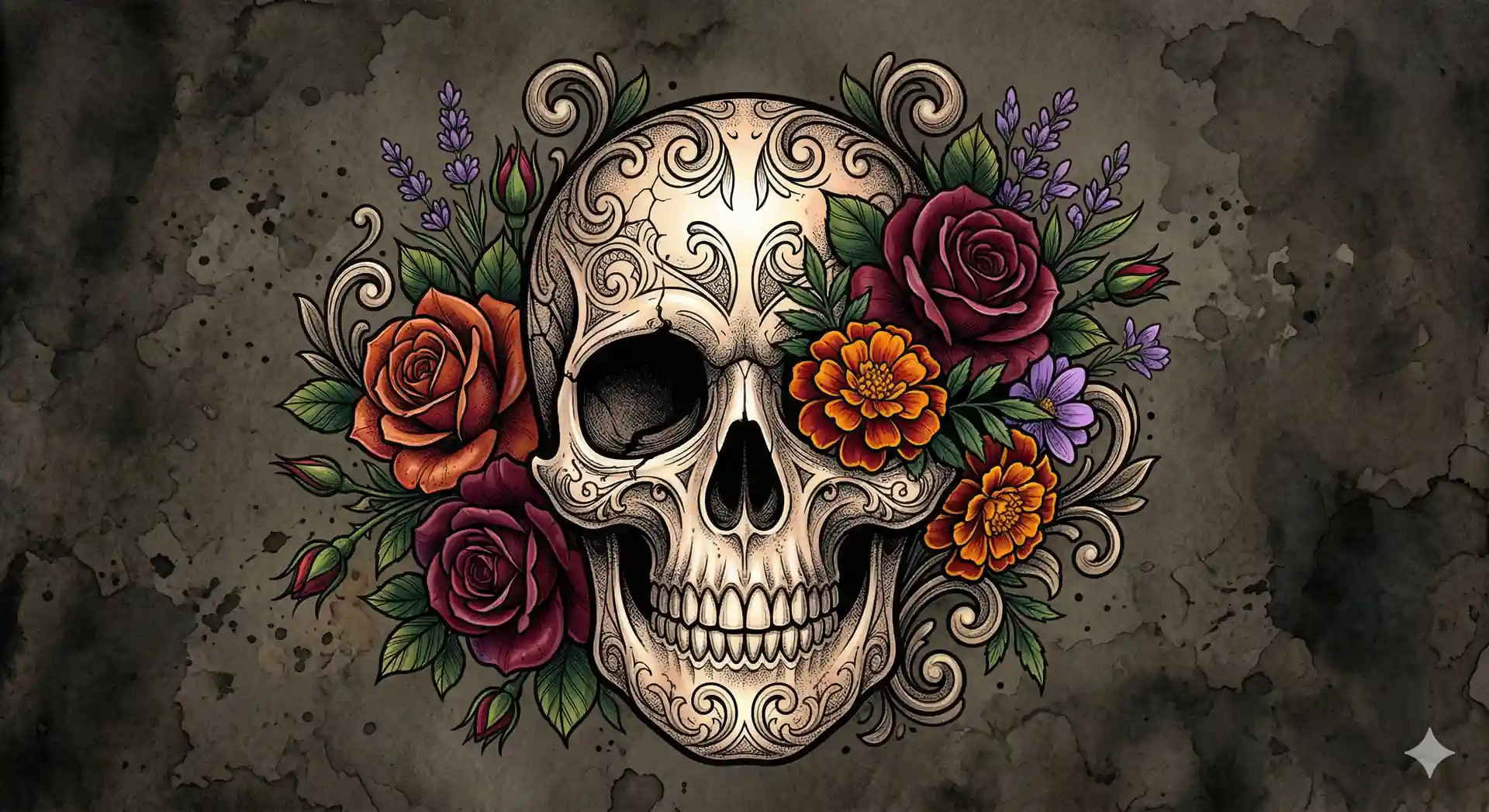
The skull is one of the oldest, most universally recognized symbols in human art — and one of the most misunderstood in tattoo culture. Ask someone what a skull tattoo means, and they'll probably say "death." Ask someone who actually has one, and the answer is almost always more interesting than that.
Skull tattoos carry meanings that span ancient Mexican spirituality, biker rebellion, military honor, philosophical meditation, and pure aesthetic boldness. They work in every major tattoo style — from the ultra-detailed realism of a cracked cranium to the bold geometry of a simplified blackwork skull, from the ornate florals of a Day of the Dead design to the playful grotesque of American traditional flash. No other symbol in tattooing has this range.
This guide covers everything: what skull tattoos actually mean across cultures, every major style and its visual language, the best placements for different sizes and designs, how to work with an artist to create something original, and how AI tools are changing how people approach skull tattoo design.
What Does a Skull Tattoo Mean?
The skull's symbolic meaning is far richer than the standard "death" shorthand suggests. Across cultures and centuries, the skull has been used to represent:
Mortality and memento mori — The Latin phrase memento mori means "remember you will die." It's not a morbid sentiment — it's a philosophical one. A skull tattoo in this tradition is a reminder to live fully, to not waste time on things that don't matter, to treat each day as meaningful because it's finite. This is the oldest and deepest symbolic use of the skull, going back to Roman dining customs and medieval European art.
Triumph over death — Paradoxically, the skull is also used to represent survival. In many traditions, wearing the image of death is a way of saying "death doesn't frighten me." Biker culture adopted the skull for exactly this reason. Military and tactical communities use it similarly.
Celebration of life — In Mexican Día de los Muertos tradition, the skull (calavera) is colorful, decorated with flowers, and joyful. The sugar skull is not a symbol of grief but of connection — honoring the dead, celebrating their lives, maintaining the bond between the living and those who have passed. This is the happiest tradition in skull symbolism.
Protection and power — In many cultures, skulls were placed at entrances or on weapons to ward off enemies. The skull says: "I am not afraid of you." A skull tattoo can carry this meaning — a protective talisman, a symbol of personal power, a declaration of toughness.
Brotherhood and belonging — From pirate flags to motorcycle clubs to military units, the skull has served as a group symbol, a mark of membership in communities built on risk and brotherhood.
Transformation and change — The skull is what remains after the body transforms. Some people get skull tattoos to mark a major personal transformation — surviving an illness, leaving a past life behind, beginning something new.
The meaning of your skull tattoo is ultimately yours to determine. Most people who get them settle on something personal — a mix of the philosophical and the aesthetic.
Major Skull Tattoo Styles
Skull tattoos work across virtually every tattoo style. Here are the major approaches and what makes each distinctive.
American Traditional Skull
The American traditional skull is one of the most iconic images in tattoo history — bold black outlines, limited color palette (typically black, red, yellow, green), minimal shading, and a flat graphic quality. Traditional skull tattoos are often paired with roses, daggers, flames, banners, snakes, or eagles.
Visual characteristics: Heavy outline, flat fill, limited but saturated color, symbolic simplicity Best for: Classic, timeless look that ages exceptionally well Common variations: Skull with roses (love and death), skull with dagger, skull with flames, pirate skull and crossbones
Neo-Traditional Skull
Neo-traditional takes the boldness of American traditional and adds dimension — more detailed shading, a wider color palette, illustrative flourishes, and contemporary compositional sensibility. Neo-traditional skulls often have flowers growing through them, detailed cracks, decorative elements like jewelry or crowns.
Visual characteristics: Strong outlines, rich color and shading, illustrative detail, contemporary feel Best for: Clients who want color and detail with strong visual impact Common variations: Floral skull (peonies, roses blooming from the skull), jeweled skull, crowned skull
Blackwork Skull
Blackwork skulls use only black ink — often in bold, graphic ways with heavy contrast. This can range from simple bold silhouettes to intensely detailed black-filled designs with negative space used as a design element. Some blackwork skulls incorporate geometric elements, mandalas, or abstract patterns.
Visual characteristics: Black ink only, high contrast, graphic impact, bold or intricate Best for: Striking, graphic impact; ages extremely well Common variations: Geometric skull, ornamental blackwork skull, abstract skull
Realistic Skull
Realism brings photographic or anatomical accuracy to skull tattoos. A skilled realist tattoo artist can render the three-dimensional structure of a human skull with depth, shadow, and texture that looks almost like a photograph embedded in skin. Some realism skulls incorporate other elements — flowers, smoke, fire, eyes — in photorealistic style.
Visual characteristics: Photographic detail, dimensional shading, anatomical accuracy Best for: Clients who want maximum visual impact and technically impressive work Common variations: Half-skull half-face portrait, skull with flowers, animal skulls (bull, ram, stag), crystal skull
Chicano Skull
Chicano tattooing emerged from Mexican-American communities in California, blending traditional religious iconography, Mexican folk art, and fine line black-and-gray technique. Chicano skulls are often rendered in detailed black and gray, sometimes incorporating religious elements, roses, script, and portraiture.
Visual characteristics: Black and gray, fine line and intricate shading, religious or cultural iconography Best for: Deeply personal work with cultural resonance Common variations: Skull with La Santa Muerte imagery, skull with rosary, skull portrait
Sugar Skull / Day of the Dead
Sugar skulls (calaveras de azúcar) are the most colorful and celebratory skull tattoo style, rooted in Mexican Día de los Muertos tradition. They feature symmetrical floral patterns, vibrant colors, stylized eye socket designs, and intricate decorative elements. Sugar skull tattoos are often personalized with specific flowers, colors, or imagery associated with a loved one who has passed.
Visual characteristics: Symmetrical, colorful, highly decorated, floral motifs, celebratory Best for: Honoring deceased loved ones, celebration of life Common variations: Sugar skull with marigolds (traditional Day of the Dead flower), feminine sugar skull with roses, sugar skull portrait tribute
Japanese-Inspired Skull
Japanese tattooing (irezumi) has its own skull tradition — the skull appears in combination with koi, phoenixes, demons (oni), snakes, and cherry blossoms. Japanese skulls often have a more elongated, stylized quality than Western skull designs, and are typically part of larger compositions.
Visual characteristics: Bold outlines, Japanese color palette, integrated into larger scenes Best for: Japanese-style sleeves or large pieces Common variations: Skull with koi, skull with snake, skull with cherry blossoms
Fine Line Skull
Fine line tattooing uses single-needle work to create delicate, highly detailed skull designs. These are the skulls you see on the forearm that look almost drawn rather than tattooed — intricate geometric, botanical, or purely anatomical work in the thinnest possible lines.
Visual characteristics: Delicate, precise, minimal weight, highly detailed Best for: Subtle, sophisticated aesthetic; smaller pieces Common variations: Geometric fine line skull, anatomical skull with botanical elements, minimalist skull
Popular Skull Tattoo Designs and Their Meanings
| Design | Style | Common Meaning |
|---|---|---|
| Skull with roses | Traditional, Neo-trad | Love and death; beauty and mortality |
| Skull with butterfly | Illustrative, Fine line | Transformation, life cycle |
| Skull with clock | Realism, Blackwork | Memento mori, time passing |
| Day of the Dead sugar skull | Chicano, Illustrative | Honoring loved ones, celebration of life |
| Ram/bull skull | Realism, Blackwork | Masculine power, strength |
| Crystal skull | Realism | Mystery, spiritual clarity |
| Half skull half face | Realism, Portrait | Duality of life and death |
| Geometric skull | Blackwork, Fine line | Modern aesthetic, mathematical perfection |
| Skull with flames | American Traditional | Intensity, hell imagery, rebellion |
| Crowned skull | Neo-traditional | Death as king, ruling over mortality |
Skull Tattoo Placement Guide
Full Sleeve Segments
The skull is a natural centerpiece for sleeve tattoos. A large skull on the upper arm or shoulder creates an anchor point from which other elements extend. Japanese-style sleeves often place skulls in the interior of a composition surrounded by waves, flowers, or mythological elements.
Chest
Chest placement is powerful for skull tattoos — centered or offset, the chest provides a large canvas that allows for size and detail. A chest skull can range from a small sternum piece to a large pectoral composition. Chest tattoos have strong personal significance, placed close to the heart.
Hand and Knuckles
Hand placements — particularly the back of the hand — are popular for skull tattoos in traditional and blackwork styles. The skull's natural shape fits the back of the hand well. Note that hand tattoos fade faster than other placements due to friction and sun exposure, and many artists charge premium rates or require existing work.
Forearm
The forearm is one of the most popular placements for medium-sized skull tattoos, particularly in realism, neo-traditional, and fine line styles. The forearm's visibility makes it a statement piece, and its relatively flat surface works well for detailed designs.
Thigh
The outer thigh offers a large, relatively flat canvas ideal for detailed skull compositions — particularly large-format pieces like sugar skull tributes or Japanese-style scenes. The thigh also provides enough space for surrounding elements like flowers, script, or decorative borders.
Back of Arm (Tricep)
The tricep placement offers a strong canvas for medium to large skull designs that is visible when the arm is down but not prominently forward-facing. Traditional and blackwork skulls work particularly well here.
Neck and Head
Skull tattoos on the neck, behind the ear, or on the head are some of the most committed and visible placements possible. These are for people who have made a deliberate choice about visibility. Typically done in simpler designs due to the curve of these areas.
Shin and Calf
The calf is an underrated placement for skull tattoos — a large, relatively flat canvas that's visible with shorts and jeans. Sugar skull and neo-traditional designs work particularly well here.
Combining Skulls with Other Elements
Skulls rarely appear alone in tattoo compositions. The most popular combinations:
Skull + roses — The classic pairing. Roses represent beauty, passion, and impermanence; combined with a skull, the image captures the coexistence of love and death. Found in every style from American traditional to fine line.
Skull + snake — A snake wrapped around or through a skull appears across American traditional, Japanese, and neo-traditional work. The snake represents transformation (shedding skin), wisdom, and danger. Together they amplify themes of power and mortality.
Skull + clock — A popular memento mori combination. The clock stops, time runs out. Clocks may show meaningful times — the time of someone's birth, or a moment of personal significance.
Skull + butterfly — The butterfly represents transformation and the soul departing the body. Skull + butterfly captures the cycle of life and the beauty of change.
Skull + crown — "Death is the king of all" — or alternatively, "I am king of my own mortality." Crown and skull combinations appear frequently in neo-traditional and illustrative work.
Skull + flowers — Any flower pairing carries its own symbolism layered over the skull's mortality themes. Roses = love, marigolds = Day of the Dead, chrysanthemums = Japanese death symbolism, peonies = wealth and honor, lotus = enlightenment.
Skull + eyes — A skull with visible eyes suggests something alive within death — an undead quality, or the idea that consciousness persists.
Finding a Skull Tattoo Artist
Skull tattoos span such a wide range of styles that finding the right artist matters enormously. A traditional tattoo artist and a realism specialist have completely different skill sets.
Matching Artist to Style
- American Traditional skull: Look for artists who specialize in traditional work — bold, clean outlines, solid fills
- Realism skull: Only choose an artist with an extensive realism portfolio, including healed examples
- Sugar skull / Day of the Dead: Look for artists with experience in detailed color work and who understand the cultural context
- Fine line skull: Seek out single-needle specialists with precise, clean work in their portfolio
- Blackwork skull: Look for artists who understand negative space and bold contrast
What Makes a Great Skull Reference
When booking a consultation, bring:
- Style references — examples of skull tattoos in the style you want (not just any skull tattoo)
- Meaning notes — if your skull has personal significance, communicate this to your artist; it informs design decisions
- Scale reference — a photo of the body part with a printout of the approximate size helps artists understand what's workable
- Combination elements — if you want a skull plus other elements, bring references for those too
Red Flags to Avoid
- Artists who don't specialize in your chosen style but agree to do it anyway
- No healed work in the portfolio
- Artists who downplay the importance of placement or sizing
- Extremely low pricing for complex realism or detailed color work
Skull Tattoo Sizing and Visibility
Skull tattoos lose their impact at very small sizes — the complexity of a skull (orbital sockets, cheekbones, teeth, cranial structure) requires a minimum scale to read clearly.
Minimum recommended sizes by placement:
| Placement | Minimum Size |
|---|---|
| Wrist/ankle | 1.5 inches |
| Forearm | 2-3 inches |
| Bicep/tricep | 3-4 inches |
| Chest/back | 4+ inches |
| Thigh/calf | 4-6 inches |
Very detailed styles (realism, fine line) need more space than bold styles (American traditional, blackwork).
How AI Is Changing Skull Tattoo Design
Skull tattoos present a specific challenge for AI visualization tools that makes them particularly useful here: the symbol varies so dramatically across styles that the same basic concept — a skull — can look completely different depending on style, composition, color palette, and accompanying elements.
An AI tattoo generator allows you to explore:
- Style comparisons — see the same skull rendered in traditional, neo-traditional, realism, and blackwork before choosing
- Composition variations — skull alone vs. skull with roses vs. skull with crown, at actual scale on your intended placement
- Color exploration — the difference between a full-color sugar skull and a black-and-gray Chicano skull is enormous; AI visualization makes this comparison instant
- Personalization elements — testing different flowers, animals, or symbolic objects in combination with the skull
The practical benefit is arriving at your consultation with a visual language that communicates your intent. Rather than showing your artist a Pinterest board of fifteen different skull styles and asking them to synthesize, you can show them a generated image that captures the specific combination of style, composition, and elements you're aiming for.
This matters especially for personal tribute tattoos — sugar skull designs that honor a specific person, or memorial pieces that incorporate meaningful symbols. Being able to visualize the overall design before committing to it reduces the chance of disappointment.
Skull Tattoo Cost Guide
Skull tattoos vary significantly in cost based on style, size, and artist skill level.
| Style | Small | Medium | Large |
|---|---|---|---|
| American Traditional | $100-200 | $200-400 | $400-800 |
| Blackwork | $120-250 | $250-500 | $500-1,000 |
| Fine Line | $150-300 | $300-600 | $600-1,200 |
| Neo-Traditional | $200-400 | $400-800 | $800-2,000 |
| Sugar Skull (color) | $250-500 | $500-1,000 | $1,000-2,500 |
| Realism | $300-600 | $600-1,500 | $1,500-4,000 |
Specialist premium: Top-tier realism artists and well-known traditional artists may charge $300-500+/hour regardless of size.
Frequently Asked Questions
Are skull tattoos bad luck? No. This is a folk superstition with no basis, and skull tattoos are among the most popular in the world. The meaning of a skull tattoo is what you bring to it.
Can skull tattoos be feminine? Absolutely. Sugar skull designs are among the most popular with female clients. Fine line and neo-traditional floral skull combinations are extremely popular across genders. The skull is not inherently masculine.
Do skull tattoos fade differently from other designs? No — aging depends on style. A bold traditional skull with thick outlines and solid fills will age as well as any traditional tattoo (very well). Fine line skulls soften over time like all fine line work. Color sugar skulls require the same care as any color tattoo.
Is a sugar skull tattoo cultural appropriation? This is a complex question. Día de los Muertos is a living Mexican and Mexican-American tradition. Many Chicano and Mexican artists tattoo sugar skull designs enthusiastically for all clients. Others feel that personal connection to the tradition or cultural background matters. The most respectful approach: research the tradition, work with an artist who has deep knowledge of it, and be thoughtful about how you wear and describe the design.
What's the difference between a skull and a calavera? A calavera is specifically the Mexican artistic tradition of the decorated, celebratory skull associated with Día de los Muertos. It differs visually and symbolically from Western skull imagery — it's brightly colored, symmetrical, and joyful rather than ominous.
Can I get a skull tattoo as my first tattoo? Yes. Many people choose skulls as their first tattoo. Consider placement carefully — your first tattoo should be in an area you're comfortable with, not somewhere highly visible if you're unsure about workplace or social reactions to skull imagery.
Designing Your Skull Tattoo
A skull tattoo rewards time spent in the design phase. The symbol is so versatile that an underdeveloped brief often produces generic work. Before your consultation:
- Choose a style — this is the most important decision. It determines everything about who your artist should be.
- Decide on size and placement — these are interconnected. Small placement = simpler design. Large placement = room for detail.
- Think about meaning — is this decorative, philosophical, memorial, or cultural? That should inform what elements you include.
- Consider what the skull is doing — facing forward vs. in profile changes the entire composition. Realistic anatomy vs. stylized. With or without a lower jaw. These details matter.
- Use AI visualization — generate variations of your concept at scale, in different styles, with different element combinations. This saves time at the consultation and dramatically improves communication.
The skull has been a tattoo staple for a reason: it carries enormous symbolic weight while working across every aesthetic. Done well, it is one of the most powerful and versatile subjects in the entire tattoo vocabulary.