Less is more. It's a philosophy that has shaped architecture, fashion, and graphic design for over a century — and in the tattoo world, it's never been more relevant. Minimalist tattoos strip away the noise: no heavy shading, no complex color gradients, no elaborate backgrounds. What remains is a clean line, a simple shape, a precise mark. And somehow, that restraint often makes them more powerful than their more elaborate counterparts.
If you're drawn to small, elegant ink — or wondering whether minimalist tattooing is the right choice for you — this guide covers everything: what defines the style, which designs work best, where to place them, how to find a skilled artist, and how to use AI tools to visualize your ideas before you commit.
What Is a Minimalist Tattoo?
Minimalist tattoos prioritize simplicity, negative space, and clean execution over complexity. They typically feature:
- Fine, precise linework — often single-needle or ultra-thin lines
- Limited or no shading — outlines and silhouettes do the heavy lifting
- Small to medium scale — most minimalist pieces are compact
- Clear negative space — the unmarked skin is part of the design
- Simple, iconic subject matter — shapes, symbols, small figures, short text
The style emerged from the broader minimalist movement in art and design, but it found its footing in tattooing in the late 2000s and early 2010s as finer needle technology and more precise machines became widely available. Today it's one of the most requested tattoo styles globally, especially for first-time clients.
Minimalist vs. fine line — what's the difference?
These terms often overlap, but they're not identical. Fine line refers to the technical approach (ultra-thin needle, delicate linework). Minimalist refers to the design philosophy (restraint, simplicity, negative space). A minimalist tattoo is almost always fine line, but a fine line tattoo isn't necessarily minimalist — it could be a highly detailed portrait rendered in thin lines, which is complex, not simple.
Why Minimalist Tattoos Are So Popular in 2026
The minimalist tattoo trend has sustained its momentum for good reasons:
Versatility — Minimalist designs work on almost any body part, at almost any size, and they translate well across professions and lifestyles. A small geometric shape on the inner wrist reads as tasteful in a corporate boardroom and stylish at a gallery opening.
First tattoo appeal — Minimalist tattoos are the most popular entry point for first-time clients. The smaller scale means lower pain and lower financial commitment, while the clean aesthetic tends to age gracefully and rarely triggers regret.
The "intentional" aesthetic — In an era of overwhelming visual complexity, choosing restraint communicates something. A single perfect line feels deliberate in a way that a heavily saturated sleeve doesn't.
AI-assisted design — Tools like AI Tattoo Generator have made it dramatically easier to visualize minimalist concepts before committing. Because the designs rely on clean shapes and clear outlines, AI generation tends to produce particularly useful results for this style.
Celebrity and cultural influence — The rise of minimalist tattoos in mainstream culture, accelerated by high-profile examples in fashion, music, and sports, has normalized the style across demographics.
Core Design Principles
A good minimalist tattoo isn't just a simple tattoo — it's a precisely considered simple tattoo. The design decisions that matter most:
Line Weight
Single-weight lines (uniform thickness throughout) create a pure, graphic look. Variable weight lines (thicker in some areas, tapering at the ends) add dimension and flow. Neither is inherently better — the choice should serve the subject. Geometric shapes often look sharpest with uniform weight; organic forms like leaves or faces benefit from variation.
Negative Space
The skin around your tattoo is part of the composition. Skilled minimalist artists think carefully about how much unmarked skin to leave and where. This is why a small minimalist tattoo can feel perfectly balanced on a large area of skin — the negative space is doing work.
Scale
One of the most common mistakes with minimalist tattoos: going too small. Lines under a certain width will blur and spread as the tattoo ages, and details smaller than about 5mm tend to merge into a smudge over time. A general guideline: the smallest dimension of your design should be at least 1–1.5 cm to age well.
Placement Relative to Anatomy
Unlike bold traditional tattoos that can work anywhere, fine minimalist lines need to follow the natural curves and contours of the body. A straight geometric line will look bent if placed over a prominent curve. Your artist should position the design to work with the anatomy, not against it.
Popular Minimalist Tattoo Motifs
Geometric Shapes
Circles, triangles, dots, lines, and their combinations are the backbone of minimalist tattooing. Clean geometric forms look precise and intentional, age predictably, and work in almost any placement. Sacred geometry (mandalas, Metatron's cube, the Fibonacci spiral) blends meaning with form.
Botanical and Floral
Single stems, small leaves, a lone flower in outline form. Botanical minimalism is particularly popular because the forms are universally recognizable even at small scale. A single rose outline conveys everything a fully shaded rose does, with a fraction of the visual weight.
Animals and Nature
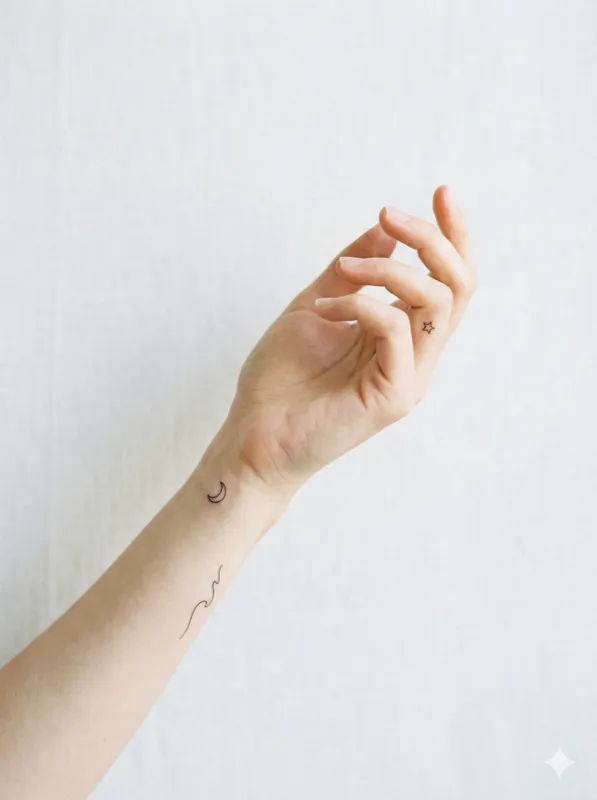
Small silhouettes — a tiny bird in flight, a mountain range reduced to three triangles, a minimalist wave, a crescent moon — function as compact symbols. The key is finding the essential gesture of the animal or landscape and committing to it without adding unnecessary detail.
Celestial Symbols
Moons, stars, constellations, and sun symbols have been among the most consistently popular minimalist designs for years. They're immediately legible, carry personal meaning for many people, and look elegant at virtually any scale.
Typography and Numbers
Single words, short phrases, important dates, coordinates, or meaningful numbers in minimal fonts. Script tattoos require a skilled artist with strong lettering ability — bad letter spacing or inconsistent line weight can undermine even the simplest text design. Avoid overly decorative fonts at small scales; they tend to blur.
Abstract and Linear
Single-line drawings (a portrait or landscape rendered as one continuous unbroken line), abstract geometric arrangements, simple marks that hold personal meaning. These are among the most distinctive minimalist designs because they're inherently unique.
Symbols and Icons
Arrows, infinity signs, heartbeats, compass roses, small anchors, musical notes — simple symbolic icons that communicate a personal value or identity. At their best these feel intentional; at their worst, generic. The difference is usually in the execution and placement.
Best Placements for Minimalist Tattoos
The smaller, more delicate nature of minimalist designs makes placement especially important.
Inner Wrist
One of the most popular spots for small minimalist pieces. Visible enough to see regularly, easy to show or conceal. The flat inner surface is forgiving for linework. Be aware: the wrist fades slightly faster than other areas due to sun exposure and friction.
Inner Forearm
Slightly more space than the wrist, still easily visible. Good for slightly larger minimalist pieces — a small constellation, a short phrase, a simple line drawing. The flat surface makes it ideal for geometric work.
Ankle and Foot
Classic placement for small, subtle designs. Slightly more painful than the forearm but very popular for minimalist work. Feet fade faster than most areas due to friction from footwear, so expect touch-ups.
Behind the Ear
A small, intimate placement that reads as deliberate and understated. Works best for very small, simple designs — a tiny star, a small symbol, a minimal geometric shape. Fades relatively quickly due to the high movement area.
Collarbone
A romantic, elegant placement that works particularly well for text, delicate botanical designs, or small geometric pieces. Slightly more painful due to bone proximity, but the visual effect is distinctive.
Spine
A vertical design running along the spine is one of the most dramatic minimalist placements — a thin line of text, a column of symbols, or a delicate botanical element. More painful than limb placements, but visually striking.
Finger
Very popular for minimalist designs, but comes with a caveat: finger tattoos fade and blur faster than almost any other placement. The skin on fingers experiences constant movement, friction, and sun exposure. Many artists recommend waiting until you've had other tattoos that have aged well before committing to fingers.
Behind the Knee and Inner Elbow
Distinctive placements that work well for small minimalist pieces. Both are more painful due to the thin skin and proximity to joints, but the unusual placement tends to make the design more memorable.
Comparing Minimalist to Adjacent Styles
| Style | Lines | Shading | Color | Scale | Aging |
|---|---|---|---|---|---|
| Minimalist | Fine, clean | None or minimal | Usually black | Small-medium | Good with proper sizing |
| Fine Line | Ultra-thin | Delicate | Black or subtle color | Any | Requires touch-ups |
| Geometric | Precise, structured | Sometimes | Usually black | Any | Very good |
| Blackwork | Bold to fine | Heavy | Black only | Any | Excellent |
| Watercolor | Loose | Painterly | Full spectrum | Medium-large | Fades without touch-ups |
How to Find the Right Minimalist Artist
Minimalist tattooing looks deceptively simple — and that simplicity is exactly what makes it unforgiving. A shaky line is immediately visible. Inconsistent spacing is obvious. There's nowhere to hide. Finding a skilled artist is critical.
What to look for in a portfolio:
- Consistent, clean linework with steady, smooth strokes
- Proper healed photos (fresh tattoos always look sharper than healed ones — ask to see how the work holds up)
- Comfortable working at small scale without overcomplicating designs
- Strong understanding of negative space and composition
Questions to ask before booking:
- What needle size do you use for minimalist work? (Single needle or 3RL are standard)
- Can I see healed examples of work this size?
- How do you approach placement relative to body curves?
- What's your touch-up policy?
Red flags:
- Artists who pressure you to make designs bigger or more complex (sometimes this is valid advice, sometimes it's a lack of fine line skill)
- No healed photos in the portfolio
- Portfolios that show only one type of minimalist design
Caring for a Minimalist Tattoo
Fine minimalist tattoos need careful aftercare — the thin lines are more vulnerable to fading during healing than bold traditional work.
First two weeks:
- Keep the tattoo clean and moisturized; use unscented, alcohol-free lotion
- Avoid soaking in water (pools, baths, ocean)
- Stay out of direct sunlight
- Don't pick or scratch any peeling skin
Long-term:
- Apply SPF 30+ sunscreen whenever the tattoo will be in direct sun — UV exposure is the primary cause of fading in minimalist work
- Expect that some fine lines may need a touch-up after 3–6 months of healing; this is normal and most reputable artists offer one free touch-up session
Using AI to Design Your Minimalist Tattoo
One of the biggest challenges with minimalist tattoos is visualizing exactly how a simple design will look on your body at the right scale and placement. This is where AI tools genuinely help.
AI Tattoo Generator lets you:
- Generate variations of simple geometric, botanical, or symbol-based designs quickly
- See how different line weights and levels of detail compare side by side
- Experiment with scale and proportion before going into the studio
- Communicate more precisely with your artist — "I want something like this" is much clearer when you have an image
For minimalist work specifically, AI generation is particularly useful because the designs don't require photorealistic rendering. A clean line drawing of a simple concept is exactly what AI handles well.
How to get the best results:
- Be specific about line style: "single line outline," "no fill," "clean geometric"
- Specify scale intention: "small enough for the inner wrist"
- Describe the negative space: "lots of open space around the design"
- Use the generated image as a starting point and conversation tool, not a final blueprint
Common Minimalist Tattoo Mistakes to Avoid
Going too small. The most frequent mistake. Designs under 1cm in their smallest dimension often look great fresh but become indistinct blobs within a few years. Trust your artist when they recommend sizing up slightly.
Choosing a placement that works against the anatomy. Straight geometric lines over curved areas, designs that bisect natural body landmarks awkwardly. Discuss placement in depth with your artist before finalizing.
Copying a design exactly from social media. Minimalist tattoos are simple enough that copying one directly often results in something generic. Use inspiration images as a starting point for a custom conversation, not a copy order.
Choosing the wrong artist. Some excellent tattooers specialize in bold traditional work but aren't as skilled at fine minimalist linework. Always check the specific portfolio section that matches what you want.
Ignoring aftercare. Minimalist tattoos are more vulnerable to fading during healing than bold work. The extra care in the first two weeks pays dividends over the lifetime of the tattoo.
Minimalist Tattoo Ideas by Category
For nature lovers: Mountain range silhouette (three simple triangles), wave outline, single leaf, pine tree, lunar phases, star map of a meaningful date
For the sentimental: Important coordinates, a date in Roman numerals, handwriting of a loved one, birth flower outline, a child's height in a simple line
For geometry fans: Sacred geometry shapes, interlocking circles (Vesica Piscis), golden ratio spiral, Platonic solids, simple triangle arrangements
For animal lovers: Small bird in flight, minimalist cat or dog silhouette, a single feather, butterfly outline, minimal koi, fox or wolf head in line art
For text: A single meaningful word, a short phrase in minimal font, a quote reduced to its essential line, initials in a clean typeface
FAQ
Do minimalist tattoos hurt less?
The pain depends more on placement than style. A minimalist tattoo in a sensitive spot (ribs, foot, spine) will hurt more than a larger piece in a less sensitive area (outer forearm, outer calf). That said, minimalist pieces tend to be smaller and faster — meaning the session is shorter, which helps.
How long does a minimalist tattoo take?
Small minimalist pieces (under 3 inches) often take 30–60 minutes. Even for something that looks simple, setup, stenciling, and placement discussions add time. Budget at least 90 minutes for a studio visit, even for a small piece.
Will a minimalist tattoo age well?
With proper sizing, skilled execution, and good aftercare, yes — minimalist tattoos can age beautifully. The main risks are going too small (lines blur) and excessive sun exposure (fading). A slightly larger version of your design will almost always age better than the smallest possible version.
Can I get a minimalist tattoo in color?
Yes, though black is the most common choice. Subtle colors — dusty rose, sage green, soft blue — can work well in minimalist designs. Avoid very light colors (white, yellow, pale pink) which fade quickly and are hard to see long-term.
How much do minimalist tattoos cost?
Most reputable studios charge a minimum of $100–150 regardless of size. A small minimalist piece from a skilled artist typically runs $150–300. Be wary of shops offering very low prices for fine work — this style is harder to execute well than it looks, and price often reflects skill level.
The Bottom Line
Minimalist tattoos are proof that restraint is its own kind of ambition. Getting a small, simple design right demands more precision and intentionality than filling a large canvas with complexity. When it works — and with the right artist, the right design, and the right placement, it almost always does — the result is lasting, versatile, and quietly powerful.
The best minimalist tattoos feel inevitable. Like the design was always supposed to be exactly that, exactly there, in exactly that weight and scale. That's not an accident. It's the result of careful thinking, skilled execution, and a clear creative vision.
Start by exploring ideas with AI Tattoo Generator to find and refine a concept that resonates, then bring your best reference images to a consultation with a skilled minimalist artist. The simplicity is the point — don't overthink it, but don't underprepare either.