
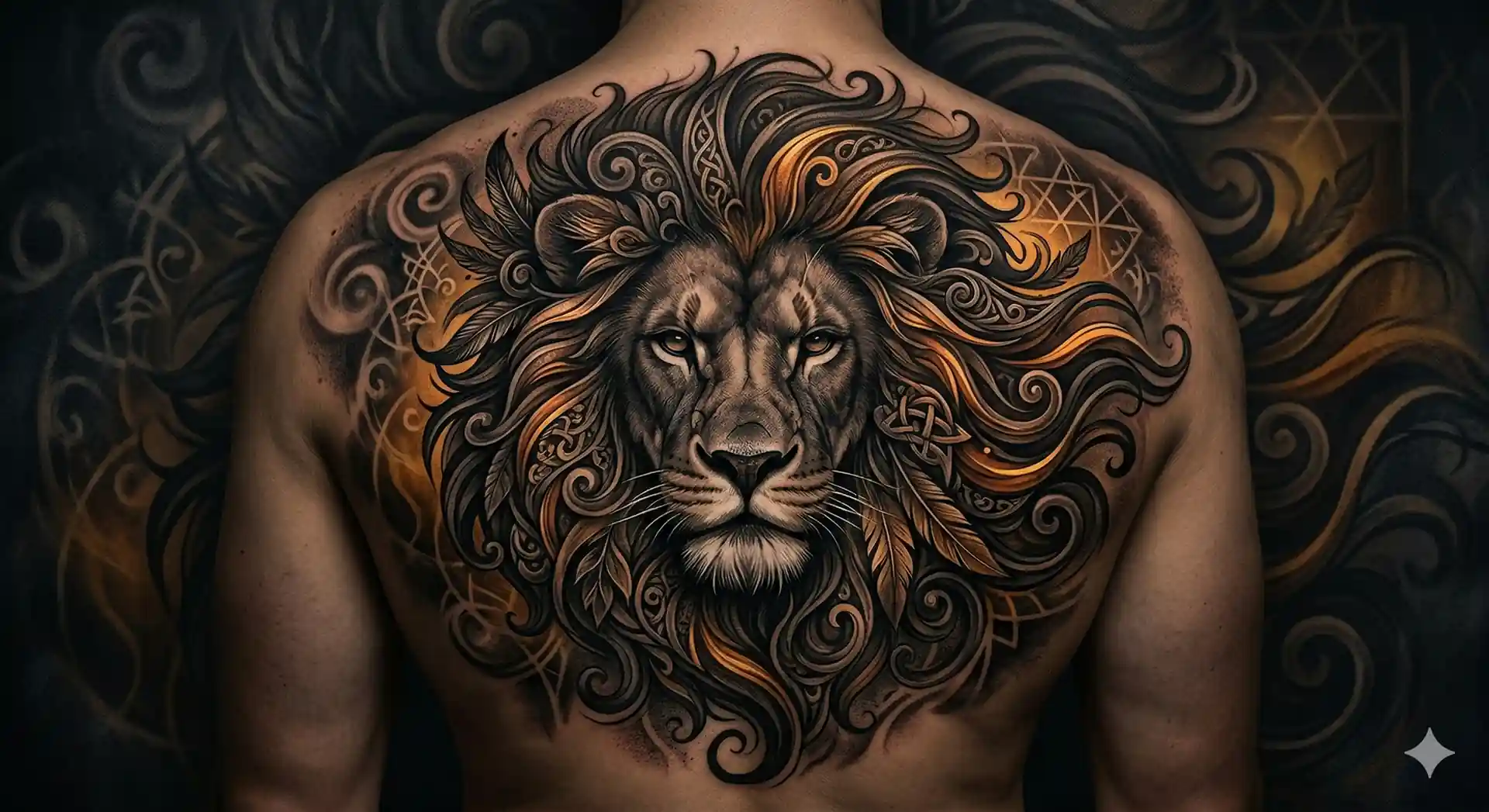
The lion is the most enduring symbol of power in human history. Across every continent, every era, and every culture that has ever encountered these animals — or simply heard of them — the lion has represented the same cluster of qualities: strength, courage, leadership, and an almost mythological dignity. It is the King of the Jungle because we decided that, millennia ago, and the title has never been challenged.
This is why lion tattoos are perennially in the top five most-requested designs in tattoo studios worldwide. They are bold, versatile, deeply meaningful, and capable of extraordinary artistic expression in virtually every tattoo style ever developed. A lion can be a delicate fine-line piece on a wrist or a hyper-realistic portrait taking up an entire back. It can be ancient and traditional or cutting-edge and surreal.
If you're considering a lion tattoo — or you're deep into the research phase — this guide covers everything: the symbolism, the cultural meanings, every major style available today, the best placements for different aesthetics and body types, color considerations, and how to find the right artist to execute your vision.
What Does a Lion Tattoo Mean?
Lion tattoo symbolism is not subtle. It draws from thousands of years of consistent cultural messaging, and the core meanings remain recognizable across vastly different traditions.
The foundational meanings most people attribute to lion tattoos:
- Courage and fearlessness — The lion does not avoid confrontation. It faces challenges directly. People who choose lion tattoos often want to carry a permanent reminder of this quality.
- Strength and power — Physical, emotional, or spiritual strength. The lion is one of the few tattoo symbols that communicates raw power without any negative connotation.
- Leadership and authority — The lion leads the pride, makes decisions, and protects its territory. A lion tattoo can signal that the wearer sees themselves as a natural leader, or aspires to be.
- Royalty and nobility — Lions appear on more royal crests, heraldic devices, and national emblems than any other animal. A lion tattoo carries this weight of dignity and distinction.
- Protection — In virtually every culture that has used lions symbolically, they appear as guardians. Lion tattoos can represent a protective force — either the wearer's own protective instincts or a tribute to someone who protected them.
- Calm and wisdom — A resting lion, not a roaring one, carries a different message: patience, quiet confidence, the understanding that power doesn't need to announce itself.
Roaring vs. Resting: The Design Distinction That Changes Everything
This is a detail that most lion tattoo guides skip, but it matters. A roaring lion and a calm, resting lion represent different qualities:
- Roaring lion: Active courage, aggression when provoked, fearlessness in the face of threat. It's the battle cry made permanent — "I will not be intimidated."
- Calm or resting lion: Wisdom, patience, restrained power, quiet confidence. It's the energy of a leader who doesn't need to prove anything.
Neither is better. They represent different personalities and different phases of life. Many people find themselves drawn to one or the other for reasons they initially can't articulate, and that instinct usually points toward the right choice.
Lion Tattoo Symbolism Across Cultures
The remarkable thing about the lion as a symbol is how consistent it is across cultures that had no contact with each other. When civilizations independently reach the same conclusion about an animal, that consensus carries real weight.
Ancient Egypt
The lion was one of the most sacred animals in the Egyptian pantheon. The goddess Sekhmet — one of the most powerful deities in the entire Egyptian system — was depicted with a lion's head. She embodied war, healing, and divine protection simultaneously, which captures the Egyptian understanding of the lion: a force so powerful it contained contradictions without being diminished by them.
The Sphinx — the most famous monument of the ancient world — combined a lion's body with a human head, symbolizing the pharaoh's strength guided by human wisdom. For the Egyptians, the lion was not simply powerful. It was the physical form that power took when it entered the world.
Maasai Tradition
For the Maasai people of East Africa, the lion has historically been more than a symbol — it was a rite of passage. Young Maasai warriors (moran) traditionally hunted lions as a test of courage and readiness for adulthood, a practice that marked the transition from boy to man within the community.
The lion in Maasai culture represents bravery, fertility, and the sacred responsibility to protect the community. It is not abstract symbolism — it is earned meaning, demonstrated through direct encounter.
Japanese Tattoo Tradition (Komainu)
In Japanese art and spirituality, the guardian lion-dogs known as komainu appear at the entrance to shrines and temples throughout Japan. They come in pairs — one with an open mouth, one with a closed mouth — representing the beginning and end of all things, the first and last sounds, birth and death.
In Japanese irezumi tattoo tradition, the lion takes on this guardian role: protection from evil, balance between opposing forces, and the sacred boundary between the profane world and the spiritual one. Japanese lion tattoos typically incorporate flowing lines, bold color, and compositional elements like waves, clouds, and peonies.
Celtic Tradition
The Celts, though not native to lion territory, were deeply familiar with lions through trade, conquest, and the Roman world. In Celtic symbolic tradition, the lion was associated with the highest degree of valor — the warrior who had proven themselves so completely that their courage was beyond question.
Celtic lion tattoos often incorporate the interwoven knotwork that characterizes Celtic art, creating intricate, pattern-rich designs where the lion form emerges from and returns to the endless loops of the knotwork. This represents the continuity of strength across generations and the interconnected nature of all things.
Western Heraldic Tradition
The lion dominates European heraldry. England's three golden lions, the Belgian lion, the Finnish lion, the Lion of Judah — across the continent and its diaspora, the lion became the emblem of nations, kingdoms, and royal houses. To wear a lion was to claim legitimacy, power, and the right to lead.
This heraldic meaning is accessible to anyone today: the lion with a crown is perhaps the most universally understood statement of personal authority — "I am the ruler of my own life."
Design Variations and What They Mean
| Design | Core Meaning |
|---|---|
| Roaring lion | Active courage, fearlessness, readiness for conflict |
| Calm/resting lion | Wisdom, patience, quiet confidence |
| Lion in profile | Dignity, watchful leadership, thoughtfulness |
| Lion with crown | Self-mastery, authority, ambition, royalty |
| Lioness | Fierce feminine power, independence, protective motherhood |
| Lion + cub | Parental love, family bonds, protective instinct |
| Lion + rose | Strength with vulnerability, beauty and danger united |
| Lion + snake | Overcoming enemies or internal conflict |
| Lion + clock or compass | Legacy, mortality, direction, staying true to purpose |
| Half-face lion | Duality — the composed self and the wild self |
| Lion in geometric form | The tension between instinct and order, nature and structure |
The Most Popular Lion Tattoo Styles in 2026
Realism and Hyper-Realism
Realism is the dominant style for lion tattoos right now, and it's easy to understand why. The lion — with its dense mane, complex fur texture, and luminous eyes — is one of the most visually rich subjects for realistic portraiture.
The best realistic lion tattoos capture individual strands of fur in the mane, the subtle gradation of color from the dark roots to amber tips, the weight and musculature of the jaw, and the specific quality of intelligence in the eyes. This is not a style for generalists — it requires an artist who specializes in animal realism and portrait work.
Black and grey realism remains the most popular approach: charcoal gradients, white ink highlights for the eyes and fur tips, and the full tonal range from near-black to near-white. Color realism — warm amber and gold manes against rich black backgrounds — is gaining momentum.
Best placements for realism: Chest, back, thigh — surfaces large enough to accommodate the necessary detail and flat enough to prevent distortion.
Geometric and Sacred Geometry
One of the most visually striking trends: the lion depicted as half-realistic portrait, half geometric construction. The face is rendered with photorealistic detail, while the mane dissolves into precise geometric shapes — triangles, hexagons, mandalas, dotwork grids.
This style resonates with people who feel the pull of both instinct and structure, nature and mathematics, the wild and the ordered. The design makes the internal tension visible.
Best placements: Forearm, thigh, chest — surfaces where both the realistic and geometric elements can breathe.
Minimalist and Fine Line
Small, elegant, precise. A lion rendered in clean single-needle linework, delicate sketched outlines, or pure negative space silhouette. The minimalist approach strips away everything that isn't essential and finds the lion in its most reduced form.
This style is growing fast, particularly among people who want their first tattoo or prefer a more subtle statement. A small fine-line lion on the wrist, collarbone, or inner forearm can be deeply personal without being immediately obvious.
Important note: Fine-line tattoos require more careful aftercare and are more sensitive to sun exposure than bolder styles. The lines are thinner and can fade faster.
Neo-Traditional
Bold black outlines with rich, complex color — deep golds, warm reds, forest greens, and rich blacks. Neo-traditional lion tattoos draw from the classic American traditional vocabulary but push the color palette further and add more intricate shading.
Lions in neo-traditional style are often paired with complementary motifs: crowns, roses, daggers, banners, ribbons, or floral frames. The result is visually striking and holds its color and linework well over decades.
Japanese (Irezumi)
Japanese-style lion tattoos draw from the komainu tradition, rendered in flowing irezumi technique: bold outlines, flat color planes, and dynamic compositional elements like crashing waves, cherry blossom, and storm clouds.
This style is most faithfully executed as part of a larger composition — a sleeve, a back piece, or a chest panel — where the lion can exist within its proper aesthetic environment rather than in isolation. The scale and context matter deeply in Japanese tattooing.
Color palette: Reds, blacks, greens, golden yellows. White negative space.
Tribal (Polynesian, Maori, Celtic)
Tribal lion tattoos use bold, solid black and negative space to construct the lion from traditional symbols rather than representational drawing. There is no shading, no photorealism — only the architecture of pattern.
Polynesian interpretations incorporate traditional motifs (ocean forms, koru spirals, enata figures) to build the lion form. Celtic interpretations use interwoven knotwork. The effect is a lion that emerges from cultural heritage rather than from observation.
Best placements: Upper arm, chest, shoulder, full sleeve integration.
Watercolor
Watercolor lion tattoos mimic the spontaneous, unpredictable bleeding of watercolor paint — soft edges, vibrant color bleeds, no hard outlines or minimal ones. The mane in particular lends itself to watercolor treatment: multiple warm hues (amber, orange, red, purple) blending in a way that no other part of the animal allows.
Important caveat: Watercolor tattoos age faster than styles with bold linework. Without solid outlines to contain the color, the edges can soften and the colors can migrate over time. Sun protection is essential. Touch-ups are likely at 7-10 years.
Blackwork and Dotwork
Pure black ink, rendered entirely through dense stippling (dotwork) or solid fills. These styles create striking graphic presence through contrast alone — no color, no tonal shading, only the relationship between black and skin.
Blackwork and dotwork lions often incorporate geometric elements or mandala patterns, creating designs that are simultaneously bold and intricate.
Color vs. Black and Grey: Which Should You Choose?
| Factor | Black and Grey | Color |
|---|---|---|
| Longevity | Excellent — maintains contrast for decades | Good, but reds and yellows fade faster |
| Maintenance | Low with sun protection | Higher — touch-ups more likely at 7-10 years |
| Best style fit | Realism, dotwork, fine line, tribal | Neo-traditional, watercolor, Japanese, new school |
| Skin tone | Works on all skin tones | Lighter colors (yellow, white) work best on lighter tones |
| Mane rendering | Charcoal gradients, white highlights | Amber, gold, orange, red browns |
| Visual impact | Timeless depth | Immediate vibrancy |
A practical tip: If you're uncertain, black and grey is the safer choice for longevity and versatility. If you have a specific color vision for the mane that you feel strongly about, commit to it fully — half-hearted color tattoos rarely satisfy.
Best Placement for a Lion Tattoo
Chest (Most Recommended for Large Detailed Pieces)
The chest is the classic canvas for a major lion portrait. It's broad, relatively flat, and positioned at a natural visual center — both for the wearer and for observers. A lion facing forward on the chest, mane spread across the pectoral muscles, is one of the most impactful tattoo compositions possible.
The chest also accommodates the size that realistic lion tattoos demand: 6-12 inches, enough to render individual fur strands and the depth of a realistic mane.
Placement note: The sternum (center chest) is significantly more painful than the pectoral muscles. Many people choose a slightly off-center placement to avoid the bone.
Back (The Grand Canvas)
The back is the only placement that allows for a truly awe-inspiring scale. A full-back lion — whether a portrait or a full Japanese-style composition — is among the most prestigious tattoos in any collection.
Commitment required: Large back pieces typically require multiple long sessions spread over several months. They are not impulse decisions.
Thigh (The Versatile Alternative)
The thigh is the hidden gem of lion tattoo placements. It's large, relatively flat, has lower pain than the ribs or sternum, and allows for complete control over visibility — a lion tattoo on the outer thigh is dramatic when revealed and invisible when dressed.
The shape of the outer thigh also accommodates the forward-facing maned lion portrait exceptionally well. Particularly popular for lioness designs.
Upper Arm and Sleeve
The upper arm is the anchor point for full sleeve compositions. A lion portrait on the upper arm, extending into a half-sleeve, is among the most popular configurations for men. The shoulder-to-elbow composition allows for a main portrait surrounded by complementary elements.
Forearm
The forearm works well for medium-size geometric or minimalist lion designs that the wearer wants visible at all times. It's always on display — choose this placement if visibility is part of the intention.
Note: The inner forearm crease experiences more stretch over time. Ultra-fine detail in this area may blur faster than on the outer forearm.
Smaller Placements (Minimalist Only)
- Wrist — Small silhouettes, simple outlines, profile views
- Ankle — Delicate minimalist designs
- Behind the ear — Single-needle micro work
- Collarbone — Elongated horizontal compositions
At these sizes, realism is not possible. Fine line or minimalist single-needle work is the appropriate choice.
How to Choose the Right Artist
The artist matters more than almost any other decision for a lion tattoo. The same design executed by different artists will produce dramatically different results.
Match artist to style, not just aesthetic:
- For realism: Find an artist whose portfolio shows animal portraits and realistic fur texture. Ask to see healed work, not just fresh pieces.
- For Japanese irezumi: Find an artist trained in the full compositional tradition of the style — not just someone who does "Japanese-inspired" work.
- For geometric/neo-trad: Look for precision linework and bold, saturated color in their portfolio.
- For fine line: Find single-needle specialists who demonstrate delicacy without losing definition.
Questions to ask in consultation:
- Have they done lion tattoos specifically? (The mane is technically demanding.)
- Can they show healed examples of large-scale work?
- What is their recommended healing protocol for a piece this size?
Aftercare for Lion Tattoos
Large, detailed lion tattoos — especially chest and back pieces — require careful aftercare.
First two weeks:
- Keep the initial bandage on for the artist-recommended time (often Saniderm for 24-72 hours)
- Wash gently twice daily with fragrance-free antibacterial soap
- Apply a thin layer of unscented moisturizer after washing
- Avoid direct sunlight, pools, hot tubs, and ocean water completely
During healing:
- Expect the design to look "dull" during the peeling phase — this is normal
- Do not pick at peeling skin — it will pull ink
- Large pieces (chest/back) typically take 4-8 weeks for full surface healing; deeper layers continue healing for 3-6 months
Long-term:
- Apply SPF 30+ sunscreen to tattooed skin before sun exposure — UV is the single greatest accelerant of fading
- Moisturize regularly — hydrated skin holds ink better
- For watercolor or color tattoos: plan for possible touch-ups at 7-10 years
FAQ
What does a lion tattoo mean? Lion tattoos most commonly represent strength, courage, leadership, and protection. The specific meaning varies by design: a roaring lion signals fearlessness and readiness for conflict, while a resting lion represents wisdom and quiet confidence.
Are lion tattoos for men or women? Lion tattoos are popular across all genders. Men tend toward chest, back, and sleeve placements with roaring or frontal portrait designs. Women often choose lioness designs, thigh placements, and fine-line or watercolor styles. But these are tendencies, not rules — the design should reflect the person, not gender conventions.
Where is the best place for a lion tattoo? For large, detailed pieces: chest, back, or thigh. For medium designs: upper arm or forearm. For small minimalist pieces: wrist, ankle, or collarbone. The chest and thigh are most frequently recommended for the combination of canvas size, pain tolerance, and visibility control they offer.
How much does a lion tattoo cost? A small fine-line lion: $150-$350. A medium detailed piece (upper arm): $400-$800. A large realistic chest piece: $800-$2,500+. A full-back composition: $3,000-$8,000+. Prices vary significantly by artist reputation, location, and complexity. For a major lion piece, the artist is not the place to economize.
How long does a lion tattoo take? A small minimalist piece: 1-2 hours. A medium detailed upper arm piece: 3-5 hours. A large chest or back piece: multiple sessions of 4-6 hours each, spread over weeks or months to allow for healing between sessions.
Design Your Lion Tattoo with AI
If you're in the early stages of exploring what your lion tattoo might look like — before you're ready to commit to a consultation — an AI tattoo generator can help you visualize different styles, placements, and compositions without any pressure.
The AI Tattoo Generator lets you describe your vision in natural language and see it rendered in different tattoo styles. It's a useful research tool for articulating what you want before you sit down with an artist — and a way to discover aesthetic directions you might not have considered.
The final tattoo will always be an artist's creation. But arriving at a consultation with a clear visual reference for the style and mood you want makes the entire process faster and produces better results.
A lion tattoo is not a casual choice — and that's exactly why it works. Its symbolism is ancient and consistent. Its visual range is extraordinary. And its capacity to be personalized — through style, variation, placement, and execution — means that no two lion tattoos are quite the same, even when they depict the same animal. That combination of universal meaning and individual expression is rare in any art form, and it's why the lion has been the King of tattoo designs for as long as there have been tattoo studios.