
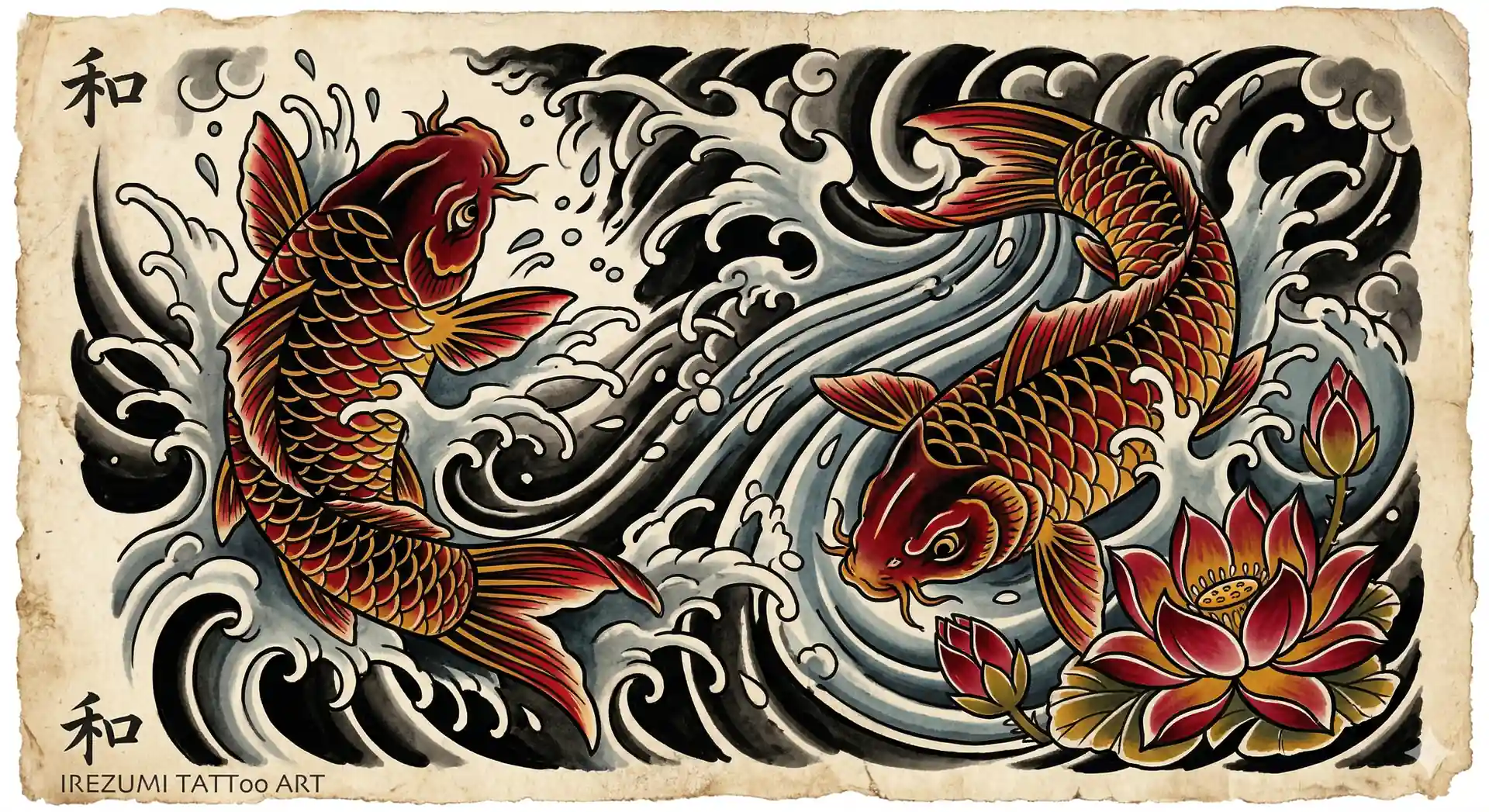
The koi fish is one of the most iconic tattoo subjects in the world — and one of the most symbolically rich. No other freshwater fish has accumulated as much meaning, mythology, and artistic tradition. A koi tattoo can mean perseverance, luck, love, courage, or transformation depending on how you design it, what colors you choose, and which direction the fish is swimming. It works in a single elegant line on your wrist or as the centerpiece of a full back piece spanning both shoulders.
Koi tattoos are among the top five most-searched tattoo subjects globally. That popularity has deep roots: the koi has been a symbol of resilience and aspiration in East Asian culture for over a thousand years, and the tattoo tradition that grew from Japanese irezumi has elevated the koi to one of the most technically demanding and visually spectacular subjects a tattoo artist can execute.
This guide covers everything you need before committing to a koi tattoo: what koi fish actually symbolize (and why direction and color matter enormously), every major design style, the best placements for different looks and body types, how to find the right artist, and how AI design tools are changing the way people visualize koi pieces before ever sitting in a chair.
What Does a Koi Fish Tattoo Mean?
Koi fish symbolism runs deep — and the details of your design carry real meaning. The same koi can mean very different things depending on color, direction, and compositional elements.
Perseverance and determination — This is the core meaning behind virtually every koi tattoo. The symbolism comes from a Chinese legend: a school of koi fish swam up the Yellow River, fighting the current, trying to reach the Dragon Gate waterfall at its source. Most gave up. The few that made it to the top were transformed by the gods into dragons. The koi that perseveres becomes something greater. A koi tattoo marks someone who has fought through difficulty — addiction, illness, trauma, failure — and kept going.
Good luck and fortune — In Japanese culture, koi (鯉, koi) are considered auspicious creatures. They are kept in garden ponds for good luck, and giving koi as a gift is a gesture of goodwill. A koi tattoo can function as a talisman: a carrier of fortune and positive energy.
Love and relationships — The Japanese word koi (恋) also means "romantic love" — a coincidence that has made koi fish a popular tattoo choice for relationship-themed pieces. Pairs of koi swimming together (especially in yin-yang compositions) often represent a romantic partnership.
Courage and masculine energy — In Japan, koi were traditionally displayed on Children's Day (now Boys' Day), with koi streamers (koinobori) flown for sons. The koi represents courage, strength, and the wish for a boy to grow into someone who faces adversity head-on.
Transformation and rebirth — The Dragon Gate legend makes the koi a natural symbol of transformation. People who have changed profoundly — in recovery, after a major life event, reinventing themselves professionally or personally — often choose koi tattoos to mark that transition.
Balance and duality — Yin-yang koi compositions (two fish swimming in opposite directions, one dark and one light) represent the complementary nature of opposing forces: masculine/feminine, action/rest, darkness/light. This is one of the most requested koi tattoo compositions.
Koi Direction: Upstream vs. Downstream
One of the most common questions about koi tattoos is about direction. It matters:
| Direction | Traditional Meaning |
|---|---|
| Upstream (swimming up) | Actively fighting adversity; in the midst of a struggle; representing the climb toward a goal |
| Downstream (swimming down) | Having overcome the challenge; at peace; moving with the current after having fought it |
Neither is "better." Upstream suits someone still in the midst of a hard period, or someone who identifies with the fighter archetype. Downstream suits someone who has come through the other side and found calm. Many people choose based on where they are in their story, not where they want to be.
Koi Color Meanings
Color is one of the most important design decisions in a koi tattoo. Traditional Japanese koi breeding developed dozens of distinct color varieties, and tattoo artists have carried those color associations into the art form:
| Color | Primary Symbolism |
|---|---|
| Red/orange (Kohaku) | Love, passion, maternal love, power |
| Black (Karasu/Kumonryu) | Overcoming adversity; transformation; often used for someone who has fought through the darkest times |
| Blue | Serenity, calm, masculine energy; often associated with sons |
| White | Success in career, purity, new beginnings |
| Gold/Yellow | Wealth, fortune, prosperity |
| Two-color (red + white) | The classic Kohaku — one of the most prized koi varieties; balance of love and purity |
For tattoo purposes, black-and-grey koi have their own powerful tradition — particularly in blackwork and Japanese-influenced styles where the shading creates the depth and movement that color might provide otherwise.
Koi Tattoo Design Styles
Koi tattoos have been interpreted in virtually every major tattoo style. Here are the most significant:
Japanese Traditional (Irezumi)
The origin style for koi tattoos. Japanese irezumi koi designs are characterized by bold black outlines, stylized scales, and dramatic compositional elements: crashing waves (namigashira), cherry blossoms (sakura), lotus flowers, water ripples, and clouds. The koi in irezumi is never just a fish — it's an actor in a scene, usually caught mid-leap, mid-swim, or mid-transformation.
Key characteristics:
- Bold, clean outlines with thick black linework
- Stylized, non-realistic scales with clear geometric pattern
- Rich, saturated colors (red, orange, gold, blue, white)
- Compositional elements that tell a story
- Large scale — typically quarter-sleeve minimum to show properly
This style demands a skilled Japanese-traditional artist. The composition and balance of irezumi pieces takes years to master. Don't rush the artist selection.
Neo-Traditional
Neo-traditional koi tattoos retain the bold outlines and compositional richness of Japanese traditional while incorporating more realistic shading, a wider color palette, and contemporary illustration influences. The scales may have more detail, the water more texture, and the overall effect is somewhere between classic and hyperreal.
This is currently the most popular interpretation for clients who want the full visual impact of a traditional koi piece with a slightly more modern aesthetic.
Realism and Hyper-Realism
Realistic koi tattoos treat the fish as a photographic subject — capturing the shimmer of scales, the transparency of fins, the play of light through water. When executed well, a realistic koi tattoo looks genuinely three-dimensional, like the fish is swimming beneath a layer of skin.
This style requires an artist who specializes in realism. Soft blending and precise light work are critical, and the results can be breathtaking — but fading is more pronounced in color realism work, so aftercare and touch-ups matter more here.
Blackwork and Black-and-Grey
Koi in blackwork or black-and-grey strip away color and let form, shading, and texture carry the design. Blackwork koi often incorporate geometric or mandala-influenced background elements. Black-and-grey koi tattoos — particularly in Japanese-influenced compositions — can be extraordinarily striking, with the shading creating all the depth that color would otherwise provide.
This is a strong choice for people who prefer the tattoo to age gracefully, as black ink holds longer and touch-ups are simpler.
Fine Line
Fine line koi tattoos are at the opposite end of the scale from bold Japanese traditional. A single delicate koi in fine line can sit on a wrist, ankle, or inner arm — small, precise, understated. Fine line koi work well in minimalist compositions, often without background elements, letting the form of the fish speak for itself.
The tradeoff: fine line work fades faster than bold linework, and very small fine line koi can blur over time. A good fine line artist knows how to build enough structure that the piece holds.
Watercolor
Watercolor koi tattoos use the flowing, bleed-edge aesthetic of the style to mimic the actual movement of a koi through water. The colors bleed and blend in ways that suggest motion rather than depict it. This can produce genuinely beautiful results — particularly for koi, where the fish's natural environment (water with light filtering through) suits the aesthetic perfectly.
Watercolor tattoos are known to fade faster than other styles, and they benefit enormously from bold underlying linework that anchors the piece as the soft colors evolve.
Dotwork
Dotwork koi tattoos use stippling to build form, shadow, and texture entirely from dots. The result is a more textural, contemplative aesthetic — less dramatic than bold Japanese traditional, more meditative. Dotwork koi are often paired with geometric or mandala backgrounds.
Koi Tattoo Compositions
Beyond single-fish designs, koi tattoos are famous for specific compositional traditions:
Yin-Yang Koi (Pisces-style)
Two koi swimming in opposite directions, forming a circular composition — one fish following the other's tail. Often one is rendered in black, one in red or gold. This is one of the most requested tattoo compositions in the world, and for good reason: the image is immediately recognizable, deeply symbolic, and translates beautifully to virtually any scale and any style.
Koi with Lotus
The koi and lotus combination is extremely common — and extremely meaningful. The lotus grows from mud to bloom above the surface; the koi swims against the current to transformation. Together they form a composition about rising above difficult circumstances through persistence. This pairing works in everything from small wrist tattoos to full sleeve compositions.
Koi with Dragon
The Dragon Gate legend explicitly connects koi and dragons — a koi becomes a dragon. Combining both in a single tattoo tells the complete story: the fish at the bottom, the dragon at the top, and the transformation in between. This is a powerful choice for a full back, chest, or sleeve piece.
Koi with Cherry Blossoms
The cherry blossom (sakura) represents the beauty and transience of life in Japanese culture — beauty that blooms briefly and falls. Koi swimming through falling sakura petals is a classic irezumi composition that speaks to living fully in the present while accepting impermanence.
Single Koi
Don't underestimate a single, well-designed koi with minimal or no background. A solitary koi swimming through open water can be strikingly bold in its simplicity — particularly in a bold Japanese traditional or neo-traditional style.
Best Placements for Koi Tattoos
Full Back
The full back is the premier location for an elaborate koi composition — the largest canvas the body offers. A full back koi piece typically features the fish as the centerpiece of a scene: waves, lotus, clouds, cherry blossoms, perhaps a dragon above. This is a lifetime commitment of time, money, and pain, but the results can be among the most spectacular in tattooing.
Sleeve (Full or Half)
The sleeve is the most common placement for koi tattoos. The arm's cylindrical form suits compositions that need to be viewed from multiple angles, and the length allows for a narrative: you can trace a koi's journey from wrist to shoulder, incorporating compositional elements that change as the eye travels up. Half-sleeves (shoulder to elbow or elbow to wrist) are a more accessible entry point.
Thigh
The thigh offers a large, relatively private canvas that suits larger koi designs. The flat, wide surface is particularly good for horizontal compositions — a koi swimming through a pond, for instance, with lotus flowers and water detail extending across the thigh.
Calf
The calf's shape complements a vertically-oriented koi swimming up or down the leg. The muscle definition shows well on a calf, and the placement is practical: visible in summer, easy to cover for work.
Chest
A koi on the chest — typically covering one pectoral and often extending to the shoulder — is a bold, intimate placement. Chest pieces hurt more than arms or thighs, but the location gives the fish a dramatic presence. This placement often works well for yin-yang compositions that mirror each other across the sternum.
Ribcage
The ribcage is one of the most painful tattoo placements, but it suits a vertical koi composition beautifully. The fish swims along the ribs from hip to armpit, with compositional elements filling the negative space. The intimacy and visibility of the rib placement — normally hidden, occasionally revealed — suits the personal nature of koi symbolism.
Ankle and Wrist
For smaller, simpler koi designs, the ankle and wrist work well — particularly fine line koi or small traditional designs. These placements fade faster and require more maintenance, but they're a beautiful entry point for someone who wants a koi tattoo without a full sleeve commitment.
Koi Tattoo Pain Guide
| Placement | Pain Level (1-10) | Notes |
|---|---|---|
| Outer arm/sleeve | 3-5 | Relatively manageable |
| Thigh | 3-5 | Large muscle, tolerable |
| Calf | 4-6 | More sensitive toward the shin |
| Chest | 6-8 | Collarbone area particularly intense |
| Ribcage | 7-9 | Thin skin over bone, breathing movement |
| Spine (back piece) | 7-9 | Increases as you approach the vertebrae |
| Inner arm | 5-7 | More nerve endings than outer arm |
| Wrist/ankle | 5-7 | Thin skin, proximity to bone |
Koi tattoo sessions for larger pieces are typically multi-session. For a full sleeve, expect 15-30+ hours total; for a full back, 30-50+ hours. Break these into 4-6 hour sessions maximum to give your body time to recover.
Choosing the Right Artist for a Koi Tattoo
Koi tattoos are not beginner artist territory. The Japanese traditional and neo-traditional styles that koi tattoos most commonly use require specific technical skills: clean bold linework, controlled color saturation, compositional understanding of how scenes wrap around the body, and knowledge of irezumi conventions.
What to look for in a koi tattoo artist:
- Portfolio with multiple completed koi or Japanese-style pieces — Not sketches or flashes: healed, finished tattoos on real clients.
- Understanding of how designs flow with body anatomy — A koi tattoo should follow the contours of the body, not fight them.
- Experience with your chosen style — A specialist in realistic portraiture and a specialist in traditional Japanese work are different artists. Find someone whose portfolio matches your vision.
- Communication during the consultation — A good artist will ask about your story, your pain tolerance, your timeline, and your budget before touching a tattoo machine.
Avoid discount tattoo shops for a piece this significant. The cost of fixing a poorly executed koi tattoo — laser removal, cover-ups — far exceeds the cost of doing it right the first time.
Koi Tattoo Aftercare
Proper aftercare determines how well your koi tattoo heals and how long the colors stay vivid.
Immediate aftercare (days 1-14):
- Keep the fresh tattoo covered with a breathable bandage or wrap for the first few hours
- Wash gently 2-3 times daily with unscented soap and pat dry
- Apply a thin layer of unscented moisturizer or tattoo-specific lotion
- Avoid submerging in water (pools, ocean, baths) until fully healed
- Stay out of direct sun while healing
Long-term care:
- Apply SPF 30+ sunscreen to tattooed areas whenever exposed to sun — UV exposure is the primary cause of color fading
- Moisturize regularly to keep the skin supple
- Schedule touch-up sessions as needed, particularly for color work and fine line detail
Color tattoos, especially bright reds and oranges in traditional koi work, require more diligent sun protection than black-and-grey pieces.
Designing Your Koi Tattoo with AI
One of the biggest challenges in planning a koi tattoo — especially a large, complex piece — is visualization. How do you know what a full sleeve koi composition will look like before committing? How do you choose between Japanese traditional and neo-traditional aesthetics? How do you settle on the right color palette?
AI tattoo generators have changed this process fundamentally.
With an AI tool like AI Tattoo Generator, you can:
- Generate multiple koi design concepts in seconds, exploring different styles (Japanese traditional, neo-traditional, blackwork, fine line) before committing to any one direction
- Experiment with color palettes — try a black koi vs. a red-and-white Kohaku vs. a gold koi to see which resonates most strongly
- Test compositions — yin-yang pairs, koi with lotus, koi with dragon, single fish in open water
- Explore directions — upstream vs. downstream, how the composition changes with the fish's orientation
- Visualize placement — generate designs sized and shaped for your intended placement, from wrist to full back
The AI can generate dozens of variations in the time it would take to sketch one by hand. This doesn't replace the tattoo artist — the AI-generated design serves as a reference and creative brief, showing your artist exactly what direction you want to explore. The best tattoo artists appreciate clients who arrive with clear visual references rather than vague descriptions.
The designs work best when you bring them to consultation as conversation starters: "I want something in this direction, but I'd love to hear how you'd execute it." A skilled Japanese traditional artist may look at an AI-generated concept and immediately suggest refinements that better suit irezumi conventions — and that input makes the final piece better.
Koi Tattoo Ideas by Meaning
If you're choosing a koi tattoo primarily for its meaning rather than aesthetics, these pairings tend to work well:
For perseverance through hardship: Black koi swimming upstream, possibly against waves, in a traditional Japanese style. The black koi in irezumi specifically represents overcoming a period of darkness.
For love and partnership: Yin-yang pair — one black, one red or gold. Works in virtually any style.
For a major transformation: Koi-to-dragon composition — the fish at the bottom, the dragon above, transformation mid-scene on a back or sleeve.
For new beginnings: White koi swimming through lotus blossoms in a fine line or watercolor style. Clean, uncluttered, forward-facing.
For luck and prosperity: Gold or yellow koi in a traditional Japanese style, swimming upward with full compositional elements.
For masculine strength and courage: Bold red or orange traditional koi, upstream direction, heavy linework, minimal sentimentality.
Common Koi Tattoo Questions
How long does a koi tattoo take? A small wrist koi in fine line: 1-2 hours. A half-sleeve traditional koi composition: 8-15 hours over multiple sessions. A full sleeve: 20-35+ hours. A full back piece: 40-60+ hours. These are general ranges — your artist's working pace and design complexity affect the total significantly.
Do koi tattoos age well? Traditional Japanese koi tattoos with bold outlines and clean color saturation age better than most tattoo styles. The heavy black linework holds the composition even as colors soften over time. Fine line and watercolor koi need more touch-up attention as the delicate linework fades. Black-and-grey koi are among the most age-resistant.
Is there a "wrong" way to get a koi tattoo? Some purists have opinions about direction, color, and compositional elements within traditional Japanese conventions. But the honest answer is no — a tattoo is personal, and what matters is what it means to you. The symbolism is there for you to use as you see fit.
Can I combine a koi with other symbols? Absolutely. Koi pair naturally with lotus, dragons, cherry blossoms, waves, clouds, phoenixes, and skulls in both traditional and contemporary interpretations. The key is compositional coherence — make sure the elements relate to each other visually and symbolically.
What's the difference between a Japanese koi tattoo and a Chinese-influenced one? Japanese irezumi koi tattoos are characterized by bold outlines, stylized waves (namigashira), compositional formality, and specific color conventions. Chinese-influenced koi art tends toward more flowing, painterly, softer forms — closer to Chinese ink painting aesthetics. Both traditions are rich; which you choose depends on the aesthetic you're drawn to.
A koi fish tattoo is a lifelong commitment to one of tattooing's most layered, most beautiful, and most meaningful subjects. The symbolism is genuinely deep — the perseverance, the transformation, the luck — and the visual tradition behind the koi tattoo is one of the richest in the art form. Whether you're drawn to a bold traditional sleeve or a simple fine-line koi on your wrist, take the time to do it right: research your artist, understand the meaning you're carrying, and use every tool available — including AI design — to arrive at your consultation with a clear vision. The koi that made it to the Dragon Gate did so because it didn't stop. Your tattoo should be worth that journey.
Ready to visualize your koi tattoo? Try AI Tattoo Generator and explore dozens of koi designs in seconds — Japanese traditional, neo-traditional, blackwork, fine line, and more.