
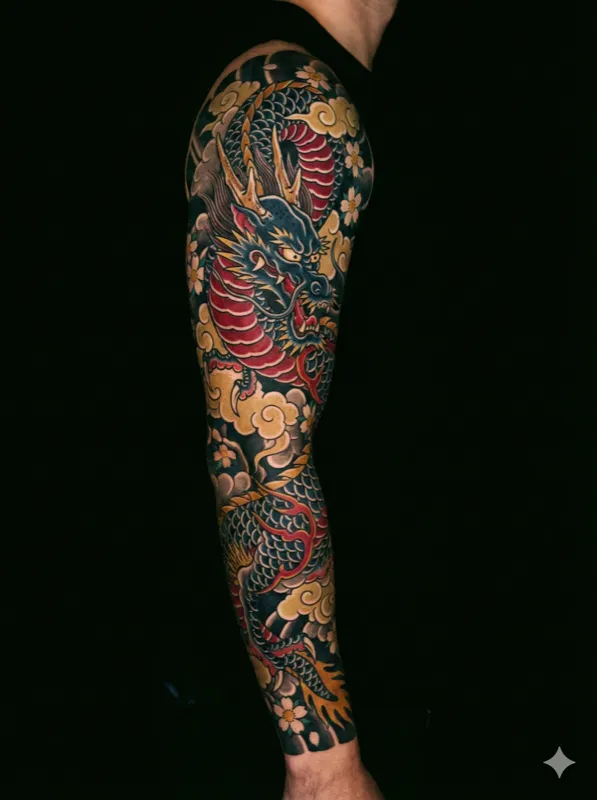
Few tattoo traditions command the same reverence as Japanese Irezumi. With a history spanning centuries, this art form is more than decoration — it's a complete visual language, a philosophy of the body, and one of the most technically demanding styles in the tattoo world.
Whether you're drawn to the sweeping drama of a full back piece or a single iconic motif on your forearm, this guide gives you everything you need to understand, plan, and commit to a Japanese tattoo you'll be proud of for life.
What Is Irezumi?
The word Irezumi (刺青) literally translates to "inserting ink." Also called Horimono ("carved thing"), it refers to the traditional Japanese style of tattooing characterized by large-scale designs that follow the body's natural contours.
Unlike Western tattoos where motifs float independently on skin, Irezumi creates a unified narrative: mythological figures are enveloped by flowing backgrounds of waves, clouds, wind bars, and seasonal flora. Everything connects. Everything tells a story.
A Brief History
Irezumi's roots run deep into Japanese history:
- Jōmon period (14,000–300 BC): Earliest evidence of tattooing in Japan, likely ceremonial
- Edo period (1603–1868): Tattooing flourished among craftsmen, firefighters, and laborers as marks of identity and group belonging
- Meiji era (1868–1912): Government banned tattooing to modernize Japan's image — driving it underground, which ironically linked it to the yakuza
- Post-WWII: American servicemen's fascination helped legitimize and export the art form globally
- Today: A thriving global art form with practitioners worldwide preserving traditional techniques alongside contemporary innovation
The Architecture of an Irezumi
A properly composed Irezumi follows strict structural principles developed over centuries. Understanding them helps you make better design decisions.
The Munewari
The most distinctive element of Irezumi body suits is the Munewari — an untattooed strip of skin running down the center of the chest and stomach. Far from an oversight, this bare channel reflects the Edo philosophy of iki: true sophistication lies in restraint, in what you don't show. It also allows the wearer to conceal the tattoo when dressed in a kimono.
The Gakubori (Background)
Irezumi backgrounds are never random filler. The Gakubori — composed of waves (nami), clouds (kumo), wind bars (kaze), and seasonal elements — serves as visual connective tissue. A skilled artist designs the background to flow with your muscle anatomy, so the composition reads differently as your body moves.
Main Subject Placement
The primary motif (dragon, koi, tiger) anchors the composition, typically:
- Back piece: Central figure spanning shoulder to lower back
- Sleeve: Coiling figure that follows the arm's curvature
- Chest panel: Subject facing inward toward the heart
Core Motifs and Their Meanings
Irezumi has a rich symbolic vocabulary. Here are the essential motifs and what they represent:
Dragon (Ryū / 龍)
The Japanese dragon is radically different from its Western counterpart. Rather than a treasure-hoarding villain, the Ryū is a bringer of blessings — a celestial creature commanding water, clouds, and rain to protect and nourish humanity.
A Ryū is a chimeric creature composed of:
- Head of a camel
- Scales of a koi
- Talons of a hawk
- Horns of a stag
- Body of a serpent
What it represents: Wisdom, protection, benevolence, and the transformative power of water. Wearing a dragon is an aspiration toward greatness.
Best placements: Full back, chest, sleeve — anywhere the long sinuous body can coil naturally
Koi Fish (Koi / 鯉)
The koi's mythology comes from an ancient Chinese legend: a koi that successfully swam upstream against the Yellow River's current and leapt Dragon Falls was transformed into a dragon. In Japanese culture, this became the ultimate symbol of perseverance rewarded.
Direction matters:
- Koi swimming upstream: Actively fighting toward a goal — perseverance, ambition, struggle
- Koi swimming downstream: Having overcome obstacles — acceptance, achievement, peace
What it represents: Transformation through effort, resilience, success born from determination
Best placements: Leg, forearm, back — designs that accommodate the fish's natural movement
Oni (鬼)
Oni are fearsome Japanese demons — horned, fang-toothed, wielding iron clubs. Westerners often misread them as "evil," but in Irezumi, the Oni is a protector.
In Japanese folklore, Oni punish the wicked and protect the virtuous. Getting an Oni tattoo is a declaration: I have the strength to face my own demons. It's a talisman of personal power.
Colors carry meaning:
- Red Oni: Passionate, wrathful, protects through intensity
- Blue Oni: Cold, calculating, enforcer of justice
What it represents: Inner strength, protection from evil, confronting darkness
Hannya (般若)
One of Irezumi's most recognizable motifs, the Hannya is a Noh theater mask depicting a woman whose consuming jealousy transformed her into a demon. Despite her terrifying appearance — golden eyes, serpentine tongue, horns — she is fundamentally tragic.
What it represents: The destructive power of obsession and jealousy; a warning that uncontrolled passion destroys what it loves
Important distinction: Unlike the Oni (a supernatural being), the Hannya was once human — making her profoundly more unsettling
Phoenix (Hō-ō / 鳳凰)
The Japanese phoenix — Hō-ō — is not quite the Greek phoenix of death and rebirth, though transformation is central to both. The Hō-ō is a celestial bird that appears only in times of peace and prosperity, embodying virtue, grace, and the eternal cycle of renewal.
What it represents: Rebirth, endurance, triumph over hardship, virtue
Best placements: Back (the wings spread beautifully), chest, upper arm
Tiger (Tora / 虎)
Tigers hold tremendous symbolic weight in East Asian traditions. In Irezumi, the tiger is typically rendered in dynamic motion — mid-leap, snarling — exuding raw power.
What it represents: Courage, raw strength, protection against evil spirits and bad luck, control of wind
Classic pairing: Tiger and dragon are traditional counterparts — earth versus sky, brute strength versus celestial wisdom. A tattoo featuring both represents the harmony of opposing forces.
Cherry Blossoms (Sakura / 桜)
Perhaps Japan's most universally recognized symbol, the cherry blossom blooms for only one to two weeks before falling. This brief, spectacular beauty made sakura the defining image of mono no aware — the bittersweet awareness of impermanence.
What it represents: The fleeting nature of life, beauty in transience, living fully in the present
Role in composition: Sakura is almost always used as a supporting element, drifting petals filling space and adding seasonal context
Waves (Nami / 波)
Waves — particularly the bold, stylized Great Wave-style rendering — are among Irezumi's most iconic backgrounds. They represent the ocean's constant movement: powerful, indifferent, and eternal.
What it represents: The natural world's power, life's constant change and flow, strength in adversity
Motif Pairing Guide
| Primary Motif | Natural Pairings | Meaning Combination |
|---|---|---|
| Dragon | Clouds, waves, pearls | Celestial power over natural forces |
| Koi | Waves, lotus, water lilies | Transformation through struggle |
| Tiger | Bamboo, pine, wind bars | Earth-bound strength and endurance |
| Phoenix | Cherry blossoms, flames | Rebirth and fleeting beauty |
| Hannya | Serpents, autumn leaves | Jealousy's destructive spiral |
| Oni | Lightning, clouds | Supernatural protection |
Traditional Techniques: Tebori vs. Machine
Authentic Irezumi was historically applied using tebori — hand-poking ink into skin using bamboo or metal-tipped tools held and moved manually by the artist. This slow, meditative process creates a distinctive texture: ink sits slightly differently in the skin, with a softer, slightly mottled quality that many collectors prefer.
Today, most traditional Japanese tattoo artists use rotary machines for efficiency and consistency without sacrificing quality. What matters more than the tool is the artist's mastery of Irezumi composition and their understanding of how traditional motifs should flow on the human body.
Some artists offer both options. If you're interested in tebori specifically, ask explicitly — it typically adds significant time and cost.
Choosing Your Placement
Irezumi placement follows centuries-old conventions, though modern artists adapt them thoughtfully:
Full Body Suit (Donburi-bori)
The ultimate commitment: coverage from neck to wrists and ankles. This takes years and tens of thousands of dollars. The Munewari (center chest strip) and face, hands, and feet are typically left bare.
Back Piece (Senaka)
The back is prime Irezumi real estate — a large canvas for a single dominant composition. Full back pieces typically take 30–80+ hours across multiple sessions.
Chest Panels (Munewari style)
Paired chest panels frame the Munewari strip, often featuring symmetrical or complementary motifs. Connects naturally to sleeves for those building toward a suit.
Sleeve (Sode)
Full sleeve (shoulder to wrist) or half sleeve (shoulder to elbow or elbow to wrist). One of the most popular Irezumi formats for those not ready for a suit.
Thigh (Momo)
Increasingly popular — the thigh offers a large, relatively flat canvas and is easily concealed. Works well for single large motifs like a dragon, koi, or phoenix.
How to Find a Qualified Irezumi Artist
Not every tattoo artist who draws Japanese imagery understands Irezumi. Here's how to find the right one:
Look for these skills:
-
Gakubori proficiency — Their portfolio should show backgrounds (waves, clouds, wind bars) that flow naturally with anatomy. If the filler looks disconnected from the body, move on.
-
Traditional color palette knowledge — Authentic Irezumi uses specific pigment relationships: reds against black, gradated blues in waves, strategic yellow highlights. Random color choices signal inexperience.
-
Compositional coherence — Even a single piece should feel like it "belongs" to a larger potential composition, even if it stands alone.
-
Understanding of motif meaning — A qualified artist should be able to explain the symbolic significance of every element they draw.
Questions to ask in your consultation:
- How would you approach the background for this piece?
- How does this motif interact with my body's shape?
- What's your recommended sizing for this placement?
- Can I see healed photos from previous Japanese work?
Cost and Time Commitment
Japanese Irezumi is among the most time-intensive and expensive tattoo styles — and for good reason.
| Piece Type | Estimated Hours | Estimated Cost |
|---|---|---|
| Single motif (fist-size) | 3–6 hours | $400–$900 |
| Half sleeve | 15–25 hours | $2,000–$5,000 |
| Full sleeve | 30–50 hours | $4,000–$10,000 |
| Chest panels | 20–35 hours | $3,000–$7,000 |
| Back piece | 40–80+ hours | $6,000–$20,000 |
| Full suit | 150–300+ hours | $20,000–$60,000+ |
Prices vary significantly by artist reputation, location, and experience. Top traditional Japanese specialists may charge $300–$500+/hour.
Budget tip: Never compromise on artist quality to save money on Irezumi. The design complexity and healing requirements mean that fixing poor Irezumi work is extremely difficult and often impossible.
Cultural Considerations
Japanese tattooing exists within a complex cultural context that deserves acknowledgment:
The yakuza connection: For most of the 20th century, Irezumi was associated with organized crime in Japan. This stigma persists — many Japanese public baths (onsen), gyms, and swimming pools still ban tattooed visitors.
Cultural appreciation vs. appropriation: This is a nuanced conversation within the tattoo community. Most Irezumi artists and enthusiasts — including many Japanese practitioners — welcome sincere appreciation of the art form. The key is approaching it with genuine respect: understanding the symbolism, choosing motifs that connect to your values, and working with artists who have deep knowledge of the tradition.
What to avoid: Randomly mixing Irezumi motifs without understanding their significance, or pairing Japanese imagery with symbols from other traditions without thoughtful intent.
Planning Your First Irezumi: Step-by-Step
-
Research extensively — Spend at least 2–3 months studying the style before booking. Follow Irezumi artists on Instagram, read histories, understand the motifs.
-
Define your scope — Single piece, sleeve, or long-term suit? This determines which artists to approach (some only take on suit projects).
-
Create a reference folder — Collect 15–30 images that capture the aesthetic you want. Include full pieces, backgrounds, specific motifs.
-
Book consultations with 2–3 artists — Never commit after a single consultation. Different artists have different strengths.
-
Discuss a multi-year roadmap — If you're building toward a suit, a good artist will plan the overall composition before starting session one.
-
Prepare for long sessions — Traditional Japanese work often runs 4–6 hours per session. Eat well beforehand, stay hydrated, and rest after.
-
Follow aftercare religiously — Irezumi's bold colors and detailed backgrounds require perfect healing. Follow your artist's specific instructions without shortcuts.
Designing Your Irezumi with AI Tools
Planning a large-scale Irezumi involves significant creative vision — imagining how a motif will look on your specific body, in your chosen color palette, scaled appropriately. AI tattoo design tools have become valuable planning instruments.
An AI tattoo generator can help you:
- Visualize motif combinations before committing to an artist
- Explore color palette options — traditional red/black vs. more subdued approaches
- Experiment with placement — see how a dragon or koi would look on your arm vs. your back
- Generate reference images to bring to your consultation
AI tools don't replace the expertise of a skilled Irezumi artist — but they can sharpen your vision and make your consultation far more productive.
Frequently Asked Questions
How long does a full back Irezumi take to complete? Typically 40–80+ hours spread across 6–24 months of sessions. Most artists prefer to schedule sessions 6–8 weeks apart to allow proper healing between appointments.
Does Irezumi hurt more than other tattoo styles? The pain level depends on placement, not style. However, Irezumi often involves extensive black shading and color packing over large areas, which can be more intense than line work. Sessions are long, so fatigue is a factor.
Can I start with a small Japanese-style piece? Absolutely. Many collectors start with a single motif — a koi on the forearm, a dragon on the shoulder — and expand over years. Tell your artist your long-term intentions upfront so they can position the first piece within a cohesive potential composition.
Is Irezumi appropriate if I have no Japanese heritage? This is a personal decision that the tattoo community continues to debate. Most traditional Irezumi artists — including Japanese masters — welcome international clients who approach the art form with genuine respect and understanding. Research the symbolism, work with a knowledgeable artist, and choose motifs that carry personal meaning.
How do I maintain the vibrancy of Irezumi colors long-term? Sun protection is critical — UV exposure fades colored tattoos significantly. Use SPF 50+ on all exposed tattoos year-round. Keep skin moisturized. Large pieces may benefit from touch-up sessions every 5–10 years, depending on skin type and sun exposure.
What's the difference between traditional Japanese and neo-traditional Japanese? Traditional Irezumi follows strict compositional rules and a specific motif vocabulary developed over centuries. Neo-traditional Japanese adapts those aesthetics with illustrative depth, unconventional color palettes, and more compositional freedom — it's inspired by the tradition without being bound by it.
Japanese Irezumi is one of the world's great tattoo traditions — demanding in its complexity, profound in its symbolism, and stunning in its visual impact. Whether you're planning a single iconic koi or a decades-long journey toward a full suit, approach it with research, patience, and the right artist.
Ready to start visualizing your design? Use our AI tattoo generator to explore motif combinations and find the inspiration for your Irezumi journey.