
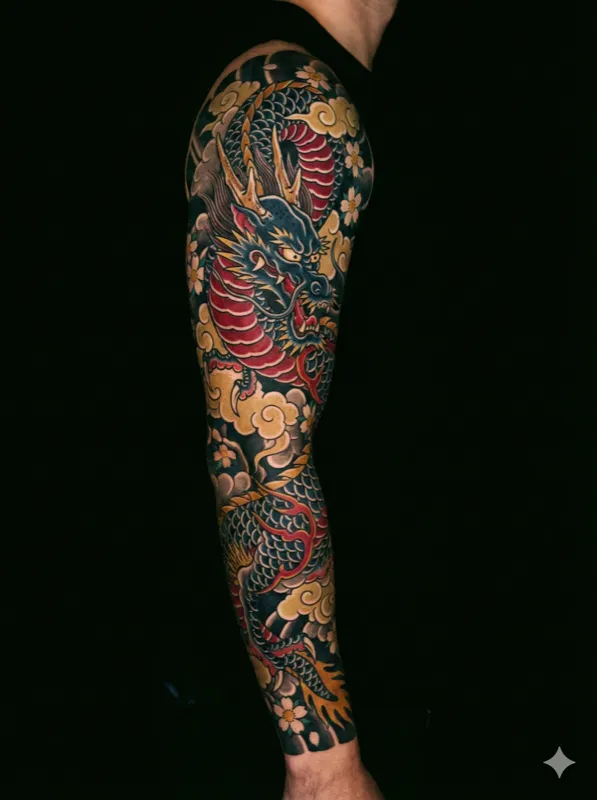
The dragon is one of the oldest and most powerful symbols in human history — and one of the most requested tattoo subjects on earth. No other mythological creature spans as many cultures, carries as much symbolic complexity, or offers as much creative range for a tattoo artist. A dragon can be terrifying or protective, destructive or wise, ancient or modern. It can wrap around an entire arm, coil across a back, or sit quietly on a wrist in fine line miniature.
This guide covers everything you need to know before committing to a dragon tattoo: what different dragon traditions actually mean, how Eastern and Western dragons differ symbolically and visually, the major styles used by artists today, the best placements for different looks and body types, pain levels, how to find the right artist for this demanding subject, and how AI design tools are changing the way people visualize their dragon pieces before ever sitting in a chair.
What Does a Dragon Tattoo Mean?
The meaning of a dragon tattoo depends almost entirely on which dragon tradition you're drawing from — and the difference between, say, a Japanese ryu and a European fire-breathing wyvern is not cosmetic. They represent fundamentally different things.
That said, certain themes run across most dragon tattoo interpretations:
- Power and strength — The dragon is the apex of mythological creatures. Across virtually every culture, the dragon represents force that cannot be easily overcome.
- Protection — In East Asian traditions especially, dragons are protectors. A dragon tattoo can mean "I am watched over" or "I am the one who watches over others."
- Transformation — Dragons are associated with elemental forces — fire, water, wind — and with the capacity to change. They shed scales, breathe transformation, and in many stories serve as agents of profound change.
- Wisdom — The dragon is ancient. Dragon tattoos often carry the meaning "I have learned something hard and carry that knowledge now."
- Duality — Many dragon designs deliberately capture the tension between destruction and creation, chaos and order. The dragon that burns also illuminates.
Eastern vs. Western Dragons: A Critical Distinction
Before you design a dragon tattoo, understand what you're actually choosing:
| Eastern Dragon (Japanese/Chinese) | Western Dragon (European) | |
|---|---|---|
| Form | Serpentine, no wings, long body | Quadruped with wings, stocky |
| Symbolism | Benevolent, wise, protective | Dangerous, hoarding, adversarial |
| Elements | Water, sky, rain, earth | Fire, destruction |
| Cultural role | Divine, imperial, auspicious | Monster to be slain |
| Tattoo associations | Strength with wisdom, protection, fortune | Power, danger, defiance |
The vast majority of dragon tattoos reference Eastern traditions — particularly Japanese irezumi dragons — because the serpentine form lends itself extraordinarily well to body-wrapping compositions. But Western dragons, Norse Lindworms, and Celtic serpent-dragons have their own strong following.
Japanese Dragon (Ryu) Symbolism
The Japanese ryu is among the most tattooed subjects in the world, and for good reason. In Japanese tradition, the dragon is a creature of water and sky — associated with rainfall, rivers, and the sea. It is powerful but not malevolent. Major symbolic meanings:
- Wisdom and longevity — The ryu lives for thousands of years and accumulates deep knowledge.
- Good fortune — A dragon tattoo can function as a protective talisman against bad luck.
- Balance — The ryu is often depicted with the phoenix (ho-oh) as its counterpart: masculine/feminine, fire/water, heaven/earth.
- Strength of character — In Japanese culture, the ryu represents the ideal of power exercised with restraint and wisdom.
Color matters in Japanese dragon tattoos:
- Blue/green — Mercy and benevolence
- Gold — Wisdom, virtue, kindness
- Black — Experience, wisdom (associated with older dragons)
- Red — Passion, the maternal
Chinese Dragon (Long) Symbolism
The Chinese long predates the Japanese ryu by millennia and shares much of the same symbolism but with imperial overtones. The five-clawed dragon was exclusively reserved for the emperor; four-clawed dragons were for nobility. Today:
- Imperial power and authority — A dragon tattoo in Chinese tradition can signal personal sovereignty
- Auspiciousness — The dragon brings good weather, good harvests, and good fortune
- Yang energy — The dragon is the male principle in Chinese cosmology, paired with the phoenix (female)
- Nine attributes — Chinese dragons were described as having nine animal features: head of a camel, eyes of a demon, ears of a cow, horns of a deer, neck of a snake, scales of a fish, claws of a hawk, paws of a tiger, and belly of a clam. Many tattoo artists incorporate these details deliberately.
Western Dragon Symbolism
The European dragon is the dragon of fairy tales and medieval maps: "Here be dragons." It hoards gold, breathes fire, and must be slain by the hero. But in tattoo culture, the Western dragon has been reclaimed:
- Defiance and power — "I am the dragon, not the knight"
- Protection through fear — The dragon keeps others away from what it guards
- Welsh pride — The red dragon of Wales is one of the oldest national symbols in Europe, and Welsh dragon tattoos carry deep cultural significance
- Norse dragon (Níðhöggr, Fáfnir) — Associated with primal chaos, the shadow self, and the cycle of destruction/creation
Celtic Dragon Symbolism
Celtic and Norse dragon traditions feature serpentine creatures without wings — often depicted devouring their own tails (ouroboros) or intertwining in knotwork. Meanings include:
- Cycles and eternity — The endless loop of the dragon eating its tail
- Sovereignty of the land — Celtic dragons are often earth-guardians
- Unity of opposites — Two intertwined dragons represent the balance of forces
7 Major Dragon Tattoo Styles
1. Japanese Irezumi Dragon
The gold standard of dragon tattoos. Japanese irezumi tradition developed dragon tattoo conventions over centuries, and the visual language is immediately recognizable: sinuous body, cloud wisps, peony or wave fills, bold outlines, and dramatic use of negative space.
Key features:
- No wings — the body undulates through clouds or waves
- Three or four claws (five is Chinese/imperial)
- Dramatic facial expression: often fierce but noble
- Surrounded by traditional fill elements: clouds, waves, flames, cherry blossoms, peonies
- Tebori (hand-poked) traditional technique creates a softer saturation that ages distinctively
Best for: Large pieces — full back, full sleeve, chest panel. The composition requires space to breathe.
Artist skill requirement: Very high. Find someone with a Japanese traditional portfolio, not just someone who "also does Japanese." This style has technical conventions that require deep familiarity.
2. Chinese Watercolor/Traditional Dragon
Inspired by classical Chinese ink painting and the visual language of Chinese imperial art. Less formalized than Japanese irezumi, with more emphasis on flowing brushwork, atmospheric wash effects, and the elongated, five-clawed form.
Key features:
- More delicate line work than Japanese style
- Often incorporates traditional Chinese motifs: clouds, waves, mountains, peonies
- Color palettes tend toward imperial gold, deep red, and jade green
- Can be executed in realistic ink-wash style
Best for: Back pieces, full sleeves, chest panels.
3. Neo-Traditional Dragon
Takes the technical vocabulary of American Traditional (bold outlines, limited palette, flat fill) and expands it with dimensional shading, more complex color ranges, and elaborate detail. Neo-traditional dragons are dramatic, graphic, and visually striking at any viewing distance.
Key features:
- Bold black outlines
- Expanded palette — jewel tones, complex shading
- Art nouveau influences — decorative fills, flowing composition
- Can incorporate Western or Eastern dragon forms
Best for: Medium-to-large pieces. Works well as standalone pieces without extensive fill.
4. Blackwork/Black-and-Grey Dragon
Dragon tattoos in pure black or black-and-grey produce some of the most visually powerful results in the medium. Without color competing for attention, the focus shifts entirely to form, line quality, and shading technique. This can produce incredibly photorealistic pieces or bold graphic designs.
Sub-styles:
- Realism black-and-grey: Hyperdetailed scales, dimensional shading, almost photographic quality
- Bold blackwork: Heavy fills, graphic negative space, bold line
- Dotwork/stippling: Texture built entirely from dots, creating a textured, almost engraved quality
Best for: Any placement. Black-and-grey ages better than color tattoos.
5. Fine Line Dragon
The fine line dragon is a more recent trend — delicate, detailed work using single-needle or fine-gauge needles to create intricate line drawings. Common in minimalist and sketch-style tattoos.
Key features:
- Hair-thin lines, minimal fill
- Can include extraordinary detail at small scale
- More restrained, elegant aesthetic
- Ages differently than traditional styles — requires touch-ups
Best for: Forearm, bicep, shoulder, smaller pieces. Not ideal for large back compositions.
6. Geometric/Mandala Dragon
Combines dragon imagery with geometric patterns — mandalas, sacred geometry, tesselated scales, or line-based abstract fills. Creates a striking fusion of the organic and the mathematical.
Best for: Chest, back, thigh. Areas where the geometric symmetry can be properly displayed.
7. Trash Polka Dragon
A German-influenced style using hyper-realistic imagery combined with abstract paint splashes, smears, and graphic black elements. Trash polka dragon tattoos are aggressive, chaotic, and visually intense — they're designed to look like a collision between realism and abstract expressionism.
Best for: Bold statements. Not for everyone, but unforgettable when executed well.
Best Dragon Tattoo Placements
Full Back: The Traditional Dragon Home
The back is the canonical space for dragon tattoos — it offers the most real estate and the clearest canvas for dramatic compositions. A Japanese-style dragon can coil from shoulder to lower back, with clouds and waves filling the negative space. Back pieces are typically multi-session work (often 15-40+ hours for full coverage).
Pain level: 6-7/10. The lower back and spine are notably more sensitive.
Visual impact: Maximum. But also: you won't easily show it in daily life.
Full Sleeve: Dragon in Motion
The sleeve — running from shoulder to wrist — is the second most popular dragon format. The cylindrical form of the arm suits the serpentine dragon body perfectly. A ryu coiling from shoulder down through the forearm, disappearing behind the elbow, and emerging at the wrist is a classic composition.
Pain level: Varies dramatically. Upper arm: 4-5/10. Elbow ditch: 8/10. Inner forearm: 5-6/10. Wrist: 6-7/10.
Visual impact: High visibility in everyday life.
Chest Panel
A dragon centered on the chest, with wings or body spread across the pectoral area, is a dramatic standalone piece. Japanese compositions often pair the dragon with the tiger or phoenix on opposite sides of the chest for a balanced panel.
Pain level: 6/10 on the pectoral, 8-9/10 near the sternum.
Best style: Japanese, neo-traditional, blackwork.
Shoulder/Upper Arm
A contained dragon composition — wrapping around the shoulder, or coiled on the upper arm — is a strong choice for a first major dragon piece. It can be built out into a sleeve later if desired.
Pain level: 3-5/10. One of the more tolerable areas.
Thigh
The thigh offers substantial canvas and is one of the least painful major placement areas. Dragon pieces can fill the outer thigh effectively, with the composition running from hip to knee.
Pain level: 3-4/10.
Forearm
A forearm dragon — particularly a fine-line or neo-traditional design — is highly visible and allows for a strong composition in a relatively contained space. The dragon can wrap the forearm or sit along the top.
Pain level: 4-5/10. Inner forearm closer to 6/10.
Placement Comparison Table
| Placement | Size Potential | Pain Level | Visibility | Best Style |
|---|---|---|---|---|
| Full back | Largest | 6-7/10 | Low (private) | Japanese, realism |
| Full sleeve | Large | 4-8/10 varies | High | Japanese, neo-trad |
| Chest | Large | 6-9/10 | Medium | Japanese, blackwork |
| Shoulder | Medium | 3-5/10 | Medium-high | Any |
| Thigh | Large | 3-4/10 | Low-medium | Any |
| Forearm | Medium | 4-6/10 | Very high | Fine line, neo-trad |
| Calf | Medium | 5-6/10 | Medium | Any |
Dragon Tattoo Design Decisions
Wings or No Wings?
This is one of the most significant design decisions for a dragon tattoo — and it's largely a cultural choice:
- Eastern traditions: No wings. The ryu and long fly through clouds without them. The body itself is the vehicle of motion.
- Western traditions: Wings are standard. The wyvern (two-legged, winged) and the classic four-legged European dragon both have prominent wings.
- Mixed/fantasy styles: Winged Asian-style dragons are popular in neo-traditional work — they blend both traditions into something distinctive.
Wings change the composition significantly. They require more space and read differently on the body.
Claws
- Three claws: Japanese tradition (lesser dragons or sea creatures)
- Four claws: Standard Japanese ryu
- Five claws: Chinese imperial dragon — use knowingly; it carries cultural weight
- Talon style: Western dragons typically have bird-of-prey talons on all four limbs
Scale Detail Level
Dragon scales are one of the most technically demanding elements in tattoo work. The level of detail you specify should match:
- The artist's capability
- The size of the piece (microscale detail doesn't survive aging on small pieces)
- The style (blackwork scales read differently from colored realistic scales)
With or Without Other Elements
Dragon tattoos are often composed with other elements:
- Japanese fills: Clouds, waves (Hokusai-style), peonies, cherry blossoms, koi fish
- Phoenix pairing: Dragon + phoenix is one of the most powerful Japanese tattoo compositions — balance and transformation
- Skulls: Western dragon tradition
- Flames: Universal; works in both Eastern and Western styles
- Geometric elements: For modern hybrid styles
- Pagodas or temples: Japanese/Chinese environment elements
How to Find the Right Artist for a Dragon Tattoo
Dragon tattoos are technically demanding. The sinuous body requires confident, flowing line work; the scales require consistent repetition without becoming mechanical; the shading requires dimensional understanding of complex organic forms. This is not a design to book with an artist who hasn't done it before.
Research Steps
1. Define your style first. Japanese irezumi has different technical requirements than neo-traditional or realism. Find artists who specialize in your target style.
2. Find portfolios, not Instagram accounts. An Instagram feed can be curated to hide weak work. Look for artist websites with portfolios that include healed photos — fresh tattoos always look better than healed ones.
3. Look specifically for dragon work. An artist who does excellent floral work may not handle dragon scales well. Look for examples of the specific subject.
4. Consult before booking. For a piece this significant, a consultation (in person or virtual) is worth the effort. Ask about their process, their experience with large pieces, their healing recommendations.
5. Don't sacrifice quality for price. Dragon tattoos require multiple sessions. A piece that costs more per session from a skilled artist will look better for longer than a cheaper piece from an inexperienced one.
Red Flags
- No examples of dragon work in the portfolio
- Pressure to book immediately without consultation
- Artists who don't ask questions about what you want
- Portfolios with no healed photos
- Anyone who claims they can recreate someone else's exact design (copying another artist's work is considered unethical in the industry)
Dragon Tattoo Pain Guide by Placement
Pain is subjective and varies by individual, but here's a realistic breakdown for common dragon placements:
Relatively comfortable (3-5/10):
- Outer thigh
- Upper arm / shoulder
- Calf (outer)
- Upper back
Moderate (5-7/10):
- Forearm (outer)
- Chest (pectoral)
- Lower back
- Inner forearm
- Shin
Significant (7-9/10):
- Spine
- Sternum
- Elbow ditch
- Inner bicep
- Ribs
- Feet / ankles
- Neck
Note on large pieces: Even comfortable placements become more painful as sessions lengthen. A full back piece that starts at 5/10 pain may feel like 7/10 by hour four. Experienced tattoo clients learn to read their body's signals and schedule breaks.
Aftercare for Dragon Tattoos
Large dragon pieces require attentive aftercare — the care principles are the same regardless of size, but coverage area matters.
First 2 weeks:
- Keep the tattoo clean (gentle unscented soap, twice daily)
- Apply thin layer of fragrance-free moisturizer (Lubriderm, Aquaphor, or artist-recommended)
- Do not submerge in water (no swimming, baths, hot tubs)
- Protect from direct sun
- Don't pick or scratch peeling skin
Long-term:
- SPF 50+ sunscreen on exposed dragon tattoos every day
- Moisturize regularly
- Touch-ups are normal for large pieces — plan for them
Color vs. Black-and-Grey aging:
- Black-and-grey ages more predictably and retains contrast longer
- Color tattoos will fade faster, especially lighter colors and flesh tones
- Japanese-style color saturation tends to hold well when done correctly
How AI Is Transforming Dragon Tattoo Design
AI tattoo design tools have created a genuinely new way to approach large, complex pieces like dragon tattoos — and for many people, the process has fundamentally changed how they communicate with artists.
Visualizing Before Committing
The traditional design process for a major dragon piece looked like this: describe what you want in words, get a rough sketch, revise, revise again, book the first session, and hope the final result matches the vision in your head. Many people ended up with pieces that surprised them — not always pleasantly.
AI tools let you generate dozens of visual references before ever visiting a studio. You can explore how a Japanese ryu looks versus a Chinese long, test whether you want wings or not, see how different color palettes affect the mood, and experiment with placement compositions — all before you've spent a single dollar.
Better Artist Communication
The most practical use of AI-generated references is improving communication with your artist. Showing an artist "I want something like this, but with these modifications" dramatically reduces the gap between client vision and artist interpretation. Artists don't have to guess; you don't have to hope.
Generating Unique Concepts
AI tools can blend styles, combine references, and generate imagery that doesn't exist in any specific artist's portfolio. This is particularly useful for dragon designs because the space of possible designs is enormous — Eastern/Western hybrids, style fusions, unusual compositions — and AI can generate novel concepts that inspire both client and artist.
What AI Can't Replace
AI generates references, not tattoos. The translation from AI-generated image to actual tattoo requires a skilled artist who understands:
- How designs age on skin
- How lines behave at different scales
- How shading techniques differ from digital rendering
- Composition for specific body placement
Use AI to find your vision. Use a qualified artist to put it on your skin.
Frequently Asked Questions
Are dragon tattoos cultural appropriation? This is a question worth thinking about seriously. Japanese and Chinese dragon traditions carry deep cultural significance. The tattoo community's general consensus: approach these traditions with respect, research, and ideally work with artists from those traditions who can bring authentic understanding to the design. Wearing a dragon because you find it aesthetically cool is different from understanding the tradition you're drawing from. Doing your research — which includes reading guides like this one — is the right starting point.
How many sessions does a dragon sleeve take? A full sleeve dragon in Japanese style typically requires 4-10 sessions, each running 4-8 hours. The total time varies enormously based on detail level, color complexity, artist speed, and how your skin takes ink. Budget 2+ years for a complete sleeve, including healing time between sessions.
Do I need to design the dragon myself? No. Most tattoo artists prefer to design the piece themselves based on your input — it's part of what you're paying for. Bring reference images (AI-generated or collected from portfolios), communicate your preferences clearly (style, color, elements, mood), and trust the artist to create something original. Asking an artist to copy another artist's exact work is considered inappropriate.
What size is too small for a dragon tattoo? Scale detail requires space. A realistic Japanese dragon with visible scales needs at least forearm-width and enough length to read properly. For very small pieces (wrist, ankle), opt for simplified linework or a small coiled design rather than trying to compress a full compositional piece.
Will my dragon tattoo look good when I'm older? Large, bold pieces with strong outlines in the Japanese or neo-traditional tradition age best. Fine line and realistic work can blur and lose contrast with time. Working with a skilled artist and doing thorough aftercare — especially sun protection — significantly extends how well any tattoo holds up.
Is a dragon tattoo bad luck? In Western superstition, some people associate certain imagery with bad luck. In Eastern tradition, the opposite is true: the dragon is strongly auspicious. This is entirely a personal and cultural belief. Millions of people with dragon tattoos do not report unusual bad fortune.
Planning Your Dragon Tattoo
If you're ready to move forward, here's a clear sequence:
- Decide on tradition — Japanese ryu, Chinese long, Western, Celtic, or your own fusion
- Choose style — Japanese irezumi, neo-traditional, blackwork, fine line, realism
- Select placement — Consider size, visibility, lifestyle, and pain tolerance
- Generate references — Use AI tools and collected images to build a clear visual brief
- Find your artist — Research portfolios specifically for dragon work in your target style
- Consult — Meet with your top choice before booking
- Plan sessions — Large dragon pieces are long-term projects; approach them that way
- Commit to aftercare — The quality of the healed piece depends as much on you as on the artist
The dragon has waited thousands of years to mean something. The right design, in the right placement, executed by the right artist, is worth taking the time to get exactly right.
Looking to visualize your dragon tattoo before booking? AI Tattoo Generator lets you generate and customize dragon tattoo concepts — Japanese ryu, Chinese long, Western dragons, and everything in between — so you can walk into your consultation with a clear visual vision.