
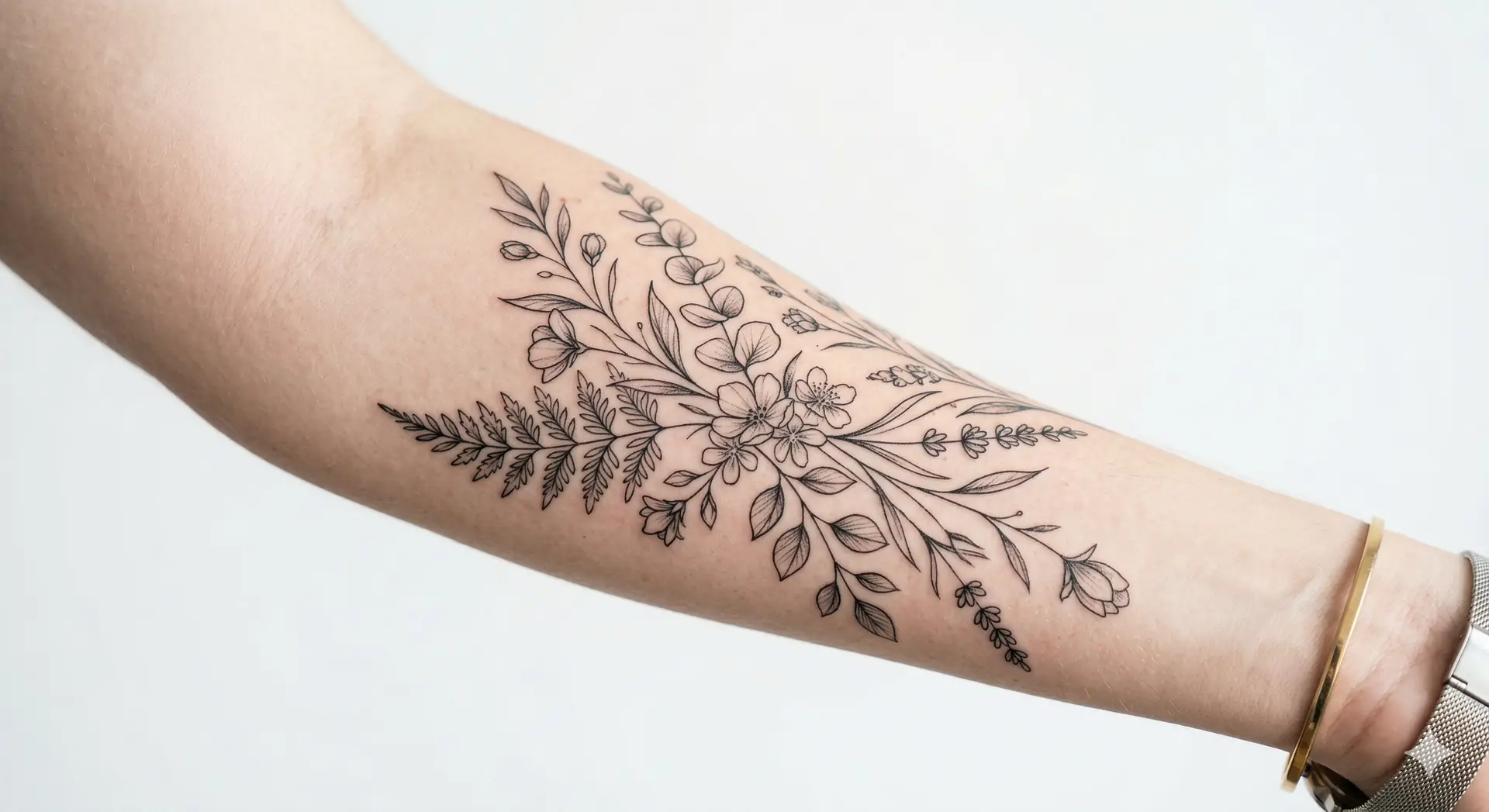
Dotwork tattoos are an exercise in patience — both for the artist creating them and the eye appreciating them. Thousands of individually placed dots, each one a deliberate decision, building together into something that looks almost impossible: depth, texture, and dimension without a single continuous line. It's pointillism applied to skin, and it's one of the most mesmerizing tattoo styles in existence.
If you've ever been stopped cold by a mandala tattoo or stared in disbelief at the shading in a geometric piece, there's a good chance you were looking at dotwork. This guide covers everything — what dotwork actually is, how it's created, the styles it encompasses, where it works best on the body, what to expect from the process, and how to find or design your perfect piece.
What Is a Dotwork Tattoo?
A dotwork tattoo creates its entire image — shading, texture, depth, and detail — using only tiny individual dots of ink. There are no solid fills, no brush-like washes, no continuous shading strokes. Just dots. The artist controls tone and contrast through dot density: tightly packed dots create dark areas, widely spaced dots create light areas, and the gradual transition between densities creates the illusion of three-dimensional depth.
The technique itself has deep roots. Ancient tattooing traditions across Polynesia, Egypt, and indigenous cultures around the world used stippling and dot-based methods. The 5,200-year-old Iceman mummy found in the Alps bore marks that historians believe were applied using a dotwork method. Modern dotwork as a distinct tattoo art form emerged as part of the broader geometric tattoo movement in the late 2000s and has grown steadily since.
What makes dotwork visually distinctive:
- No solid fills — all shading is built from individual dots
- Strong contrast between dense black areas and bare skin
- A slightly organic, textured quality even in geometric designs
- Visible stippling up close that reads as smooth shading from a distance
- An almost engraved or etched visual quality
Dotwork vs. other styles:
| Feature | Dotwork | Black & Grey | Blackwork | Fine Line |
|---|---|---|---|---|
| Shading method | Individual dots | Diluted ink washes | Solid black fills | Smooth gradients |
| Line work | Minimal/none | Present | Bold outlines | Ultra-thin lines |
| Texture | Visible dot pattern | Smooth | Flat | Smooth |
| Detail level | Very high | Very high | Moderate–High | Very high |
| Aging | Excellent | Excellent | Excellent | Good |
| Best size | Medium–Large | Any | Any | Small–Medium |
| Pain level | Low–Moderate | Moderate | Moderate | Low–Moderate |
| Artist time | Long | Moderate | Moderate | Long |
How Dotwork Tattoos Are Made
Understanding the technique helps you appreciate the artistry — and makes better conversations with your artist.
Machine Dotwork vs. Hand-Poke Dotwork
Machine dotwork uses a conventional rotary or coil tattoo machine. The artist creates individual dots using quick, controlled tap-and-lift motions rather than continuous skin contact. This requires exceptional hand control: too much pressure or too long contact creates blobs instead of dots; too little creates inconsistent depth. Machine dotwork allows larger pieces with consistent dot sizing.
Hand-poke dotwork (stick-and-poke) places each dot manually using a single needle mounted in a handle. The artist taps the needle into the skin repeatedly at controlled angles. This method produces a more organic, slightly irregular dot quality that many collectors find more aesthetically appealing. Hand-poke tends to be gentler on the skin and often produces less trauma and faster healing, though it's considerably slower for large pieces.
Which is better? Neither — they're different tools producing different aesthetics. Many traditional and spiritual dotwork motifs suit the organic quality of hand-poke. Precise geometric and mandala work often benefits from the consistency of machine application. Many specialist dotwork artists offer both.
The Technique in Practice
Skilled dotwork artists approach a piece almost like a draftsperson:
- Planning the value map — determining where the darkest, lightest, and mid-tone areas will fall before the needle touches skin
- Starting with guidelines — light initial dots to establish the composition
- Building from light to dark — establishing lighter areas first, then layering dots in denser clusters for shadows
- Controlling dot depth — adjusting needle depth for consistent ink saturation across the piece
- Managing spacing — varying the distance between dots to create smooth tonal transitions
"Dotwork demands that you think in three tones — light, mid, dark — and build everything from there. You can't erase a dot. Every placement is a commitment." — Specialist dotwork artist perspective from multiple practitioner interviews
A medium-sized dotwork mandala (roughly palm-sized) might contain tens of thousands of individual dots and take 6–12 hours of work. Large back pieces or sleeves can run 40+ hours over multiple sessions.
The Major Dotwork Styles
Dotwork isn't a single visual style — it's a technique that's applied across several distinct aesthetics.
Geometric Dotwork
The most recognizable form. Sacred geometry, Platonic solids, interlocking polygons, and mathematical patterns rendered in pure stippling. Geometric dotwork achieves a quality that's almost impossible in other styles: rigid precision combined with organic texture. The dots give geometric shapes a depth and dimension that solid linework can't replicate.
Popular geometric dotwork motifs:
- Sacred geometry — Flower of Life, Metatron's Cube, Sri Yantra
- Polyhedra and 3D forms — cubes, icosahedra, dodecahedra
- Fractals and recursive patterns — Sierpinski triangles, mandelbrot-inspired designs
- Tessellations — interlocking triangles, hexagonal grids
Mandala Dotwork
Mandalas may be dotwork's most popular application. The radial symmetry, the nested rings, the intricate petal and diamond patterns — all of it benefits enormously from stippling technique. Dotwork mandalas achieve a quality of depth and dimension that inked-solid mandalas simply can't match.
Mandala dotwork is particularly popular for:
- Sternum and chest placements (large format)
- Forearm and wrist (smaller, circular formats)
- Shoulder cap and sleeve integration
- Back pieces centered on the spine
Celestial and Esoteric Dotwork
Stars, planets, moons, suns, and cosmic imagery are natural fits for dotwork technique — space is, after all, mostly dots. Celestial dotwork often combines precise geometric structure with flowing organic elements. Occult and esoteric symbols (pentagrams, ankhs, Eye of Providence, alchemical symbols) also appear frequently in dotwork style, lending a sense of ancient gravitas.
Nature-Inspired Dotwork
Animals, botanicals, landscapes — anything with complex texture and natural shading benefits from stippling. Dotwork is particularly effective for:
- Fur and feather textures
- Tree bark and wood grain
- Stone and crystal surfaces
- Detailed insect wings
Dotwork as Background Texture
Many tattoo artists use dotwork not as the primary image but as background fill and shading in larger compositions. A traditional Japanese sleeve might use dotwork to shade water and clouds. A neo-traditional animal piece might use stippling for the ground shadow. This hybrid approach is increasingly common in contemporary tattoo design.
Best Placements for Dotwork Tattoos
The technique has specific requirements that make some body locations more suitable than others.
Ideal Placements
Flat, stable surfaces give dotwork its best results. The slight skin movement on curved surfaces can subtly distort dot spacing during application.
- Forearm (inner and outer) — flat, stable, excellent visibility, ideal for medium pieces
- Upper arm and shoulder — good canvas for larger geometric and mandala work
- Back (upper and full) — the best location for large dotwork compositions; large flat canvas, less skin movement
- Thigh (outer and front) — flat and spacious, ideal for detailed large pieces
- Chest/sternum — excellent for large mandalas; requires care around bones
- Calf — flat enough for medium to large pieces, relatively low pain
Wrist and ankle — popular for smaller mandalas and geometric pieces, though the curved surface requires an experienced dotwork artist who can compensate for the geometry.
Placements to Approach Carefully
- Hands and fingers — skin regenerates quickly here, causing dots to fade faster; not ideal for fine dotwork detail
- Ribs — the movement of breathing during the session can affect dot placement consistency, plus it's one of the most painful locations
- Feet and toes — similar regeneration issues to hands; ink sits differently in this skin
- Inner bicep — skin is soft and moves more; experienced artists can manage this but it's less predictable than flat surfaces
The Dotwork Tattoo Process: What to Expect
Consultation
A thorough consultation is more important for dotwork than for many other styles. Your artist will want to discuss:
- Size — dotwork designs need sufficient size to achieve their intended visual effect; very small dotwork risks muddy dot clusters as the ink settles
- Skin tone — dotwork's contrast reads differently on different skin tones; a skilled artist will adjust dot density and spacing accordingly
- Placement — the surface characteristics of your chosen placement affect the technical approach
- Reference and inspiration — dotwork artists typically want to see examples of the specific aesthetic you're drawn to (tight geometric vs. open flowing, mandala vs. celestial, etc.)
The Session
Dotwork sessions have a different rhythm than traditional tattooing. The constant tap-and-lift motion is less aggressive on the skin but requires longer sustained concentration from the artist. Expect:
- Longer sessions — even medium pieces often take full-day sessions; complex pieces span multiple appointments
- Lower continuous pain — the stippling motion tends to feel less intense than continuous shading, though everyone's experience varies
- More breaks — both you and the artist will need more regular pauses in longer dotwork sessions
- Less redness post-session — the gentler needle action often produces less immediate inflammation than heavy shading
Healing
Dotwork heals comparably to other black ink work. The standard guidance applies:
- Keep it clean — gentle unscented soap, twice daily for the first two weeks
- Moisturize — thin layers of fragrance-free lotion; avoid heavy petroleum products
- No sun exposure during healing — UV light breaks down fresh ink rapidly
- Don't pick or peel — the surface layer peeling is normal; pulling it disrupts dot placement beneath
- Avoid submerging in water — pools, baths, and ocean for at least 3 weeks
Dotwork-specific consideration: The dots settle slightly as healing progresses. Some artists intentionally leave the piece slightly "underdone" knowing the settling will bring it to the intended density. Discuss this with your artist before the session.
Dotwork Tattoo Longevity and Aging
One of dotwork's most underappreciated qualities is how well it ages. Solid-fill black ink eventually blurs at edges; fine line work can fade and spread; watercolor loses its crispness. Dotwork ages into itself beautifully.
As dots settle over years, the slight blending of nearby dots creates a denser, richer appearance rather than looking degraded. The overall composition remains clear because the tonal structure is built into the spacing patterns, not just the placement of ink. A 10-year-old dotwork mandala often looks more refined than it did fresh.
Factors that affect longevity:
- Sun exposure — the single biggest enemy of tattoo longevity; SPF protection on any exposed dotwork is essential
- Skin type — oilier skin types and certain anatomical areas cause faster migration
- Artist skill — consistent dot depth during application is the primary determinant of long-term appearance; inconsistent depth produces irregular fading patterns
- Touchup availability — unlike styles where touchups are complex reworks, dotwork touchups (adding density to lightened areas) are relatively straightforward
Finding the Right Dotwork Artist
This is the most important decision in the entire process. Dotwork executed without the necessary skill produces muddy, inconsistent results that can't be fixed without covering the work entirely.
What to Look For in a Portfolio
- Consistent dot sizing — dots should appear uniform in weight throughout a piece (variation is intentional for shading, not accidental)
- Clean tonal transitions — the shift from dark to light areas should be smooth, not abrupt
- Healed work — ask to see healed examples; fresh dotwork can look impressive but the true test is how it settles
- Range of complexity — an artist who can execute both tight geometric and flowing organic dotwork demonstrates genuine technical mastery
- Relevant style match — dotwork specialist ≠ just a black ink artist; look for someone whose portfolio shows extensive stippling work specifically
Questions to Ask
- What needle configurations do you prefer for dotwork?
- Do you do machine dotwork, hand-poke, or both?
- Can I see healed examples of pieces similar to what I'm planning?
- How do you approach tonal planning before starting?
- What size minimum do you recommend for this design idea?
The Pain Question
Dotwork has a reputation — often accurately — for being gentler than many other tattoo techniques. The tap-and-lift motion is less continuous skin trauma than sustained shading. However, pain is always placement-dependent and individual-dependent.
Relative pain by placement (general scale):
- Lower pain: Outer forearm, outer thigh, upper arm, calf
- Moderate pain: Inner forearm, shoulder, upper back, chest (away from sternum)
- Higher pain: Ribs, inner arm, sternum, spine, foot, wrist
- Highest pain: Ribs, ditch (inner elbow), back of knee, neck
The cumulative effect of long dotwork sessions is worth noting. Even a lower-pain placement becomes progressively more uncomfortable over 6+ hours. Building in breaks is essential.
How AI Can Help You Design Your Dotwork Tattoo
The challenge of dotwork design is visualizing the tonal structure before committing to skin. Unlike a line drawing where you can sketch and adjust easily, dotwork requires understanding how density patterns will read at different scales. This is precisely where AI tattoo generators have become genuinely useful.
Modern AI tools allow you to:
Explore compositions without commitment — Generate dozens of dotwork mandala, geometric, or celestial variations to find the spatial composition that resonates with you before narrowing down with an artist.
Understand scale and placement — AI visualization tools can show how a dotwork design might read at different sizes and on different body placements, helping you make better decisions before your consultation.
Communicate with your artist — Dotwork artists are skilled at translating ideas, but providing a visual reference (even an AI-generated one) dramatically accelerates the consultation process and reduces the chance of misaligned expectations.
Iterate on personal elements — Want a mandala that incorporates specific symbolic elements meaningful to you? AI generators can help you explore combinations and variations before your artist begins the serious design work.
The AI tool works best as a design exploration and communication tool, not as a replacement for the specialized knowledge a dotwork artist brings to execution. Use it to clarify your vision; let the artist execute it properly.
Design Ideas for Your Dotwork Tattoo
For First-Time Dotwork Clients
Start with proven combinations that showcase the technique without requiring extreme complexity or very large scale:
- Single mandala (6–8 cm diameter) on the inner forearm — clean, contained, shows well
- Geometric star or polygon with stippled shading on the upper arm
- Moon phases in dotwork across a forearm or collarbone
- Small celestial composition (sun, moon, stars) on the wrist or ankle
For Collectors Looking to Add Dotwork
- Dotwork sleeve filler — stippled background texture unifying existing pieces
- Full mandala back piece — the ultimate dotwork statement, typically 20+ hours
- Geometric chest panel extending from sternum outward
- Matching forearm mandalas in complementary but not identical designs
Themes with Particular Resonance in Dotwork
Sacred geometry — The mathematical precision of sacred geometry is complemented perfectly by the meditative quality of stippling. The time and intention invested in a dotwork sacred geometry piece adds a layer of meaning to designs already rich in symbolism.
Transformation and cycles — Mandala forms, moon phases, celestial cycles, and natural patterns all speak to themes of transformation, which resonates with the tattoo experience itself.
Precision and patience — Many collectors choose dotwork specifically because the technique embodies values they want to carry: attention to detail, patience, and the understanding that complexity can emerge from simple, repeated actions.
Frequently Asked Questions
How long does a dotwork tattoo take? Dotwork is time-intensive. A small piece (around 5 cm) typically takes 2–3 hours. A medium piece like a forearm mandala runs 6–10 hours. Large pieces like back compositions can take 30–50+ hours spread across multiple sessions.
Do dotwork tattoos fade more than other styles? No — dotwork generally ages very well. The tonal structure built through dot density remains readable as dots settle. Longevity depends more on placement and sun protection than on the technique itself.
Can dotwork be done on all skin tones? Yes, but the approach differs. On deeper skin tones, artists typically increase dot density to achieve the intended contrast, since black ink shows less contrast against darker skin. Consultation with an experienced dotwork artist who has worked with your skin tone is essential.
Is hand-poke dotwork safer than machine dotwork? Both methods are safe when performed by experienced, licensed artists using proper sterile technique. Hand-poke tends to be gentler on skin tissue and may heal faster, but this is technique-specific rather than inherently safer.
How much does a dotwork tattoo cost? Specialist dotwork artists typically charge $150–$300/hour and up. A small piece might run $300–600; a medium forearm piece $600–1,500; a large back piece $3,000–10,000+. Quality dotwork artists are rarely cheap, and this is not a style to approach budget-first.
Can dotwork be colored? Technically yes, but colored dotwork is uncommon because it loses the stark contrast that makes the style visually powerful. Most dotwork practitioners work exclusively in black ink or occasionally add subtle grey.
What's the difference between dotwork and stippling? The terms are often used interchangeably. "Stippling" refers specifically to the technique of building tone with dots; "dotwork" typically refers to the tattoo style that employs stippling as its primary or exclusive visual method. All dotwork uses stippling; not all tattoo work that incorporates some stippled shading is considered "dotwork style."
Dotwork is not for the impatient — neither for those who want instant results nor for those who can't sit through long sessions. But for collectors willing to invest in the process, it produces some of the most visually remarkable tattoos in the art form. The technique is ancient, the aesthetic is contemporary, and when it's done well, the result is genuinely unlike anything else in tattooing.
Whether you're drawn to the meditative quality of a mandala, the mathematical precision of sacred geometry, or the cosmic mystery of celestial imagery, dotwork offers a way to render those ideas on skin with depth and texture that feels almost impossible for a purely two-dimensional medium.
Ready to design your dotwork tattoo? Use our AI tattoo generator to explore geometric mandalas, sacred geometry patterns, and celestial dotwork compositions — and walk into your artist consultation with a clear visual direction.