
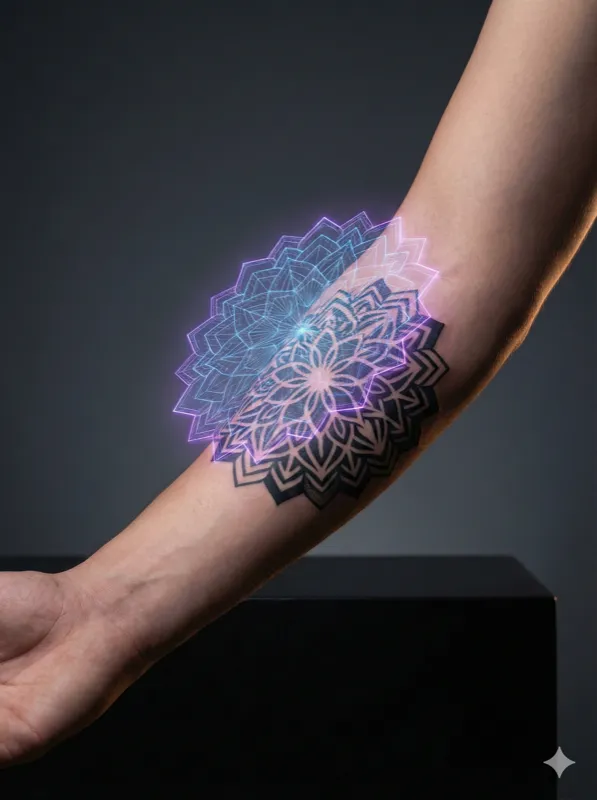
American traditional tattoos are the foundation of everything Western tattooing stands on. Bold outlines. Flat color fills. Iconic imagery. These are tattoos designed to last — and they do, aging better than almost any other style out there. Whether you call them "old school," "classic American," or just "traditional," these designs have been defining the art form for over a century.
If you're drawn to the power and permanence of this style — or want to understand why your favorite tattoo artists revere it — this guide covers everything: the history, the defining characteristics, the iconic motifs, placement strategy, how to find the right artist, and how modern tools like AI are helping people design traditional-inspired pieces.
What Is American Traditional Tattooing?
American traditional is the oldest codified Western tattoo style. It's defined by a strict set of visual rules that emerged through decades of practical evolution:
- Thick, heavy outlines — usually 3-5mm bold black lines that anchor the design and ensure longevity
- Flat color fills — solid, opaque color with minimal shading variation; no gradients, no blending
- A restricted color palette — classic red, yellow, green, black, and blue; some orange and purple
- Simple, bold compositions — every element readable at a glance, nothing fussy or overworked
- Iconic, symbolic subjects — eagles, panthers, roses, daggers, swallows, anchors, skulls, mermaids, hearts
These aren't aesthetic choices made by any one artist — they emerged from the physics of tattooing itself. Heavy outlines lock in color. Flat fills age without muddying. Bold compositions stay legible as skin changes over decades. American traditional is engineering as much as art.
How it compares to related styles:
| Style | Outlines | Color | Shading | Subject Matter |
|---|---|---|---|---|
| American Traditional | Heavy, uniform | Flat, restricted palette | Minimal | Classic icons |
| Neo-Traditional | Bold, variable | Rich, expanded | Dimensional | Broad, illustrative |
| New School | Exaggerated | Hyper-bright | Gradient-heavy | Cartoonish |
| Black and Grey | Moderate | Greyscale washes | Photorealistic | Portraits, nature |
The key distinction: American traditional prioritizes permanence and impact over detail and complexity. A well-executed traditional tattoo looks better at 40 years old than most detailed tattoos do at 10.
A History Written in Ink
Sailor Jerry and the Roots of American Traditional
The lineage of American traditional tattooing runs through maritime culture, carnival sideshows, and one of the most influential tattoo artists who ever lived: Norman "Sailor Jerry" Collins.
American tattooing took shape in port cities in the late 19th century — Chatham Square in New York under Martin Hildebrandt and, eventually, Samuel O'Reilly (who patented the first electric tattoo machine in 1891). Sailors drove the early demand: tattoos were identification, talisman, and memento rolled into one. If you drowned, your tattoo helped identify your body. If you were superstitious (and sailors were intensely superstitious), you got a swallow for every 5,000 miles sailed, or a pig and a rooster to prevent drowning.
Sailor Jerry, based in Honolulu from the 1930s onward, absorbed Japanese tattooing techniques — the draftsmanship, the compositional flow, the attention to how tattoos moved with the body — and applied them to Western imagery. He elevated traditional American tattooing from carnival novelty to genuine craft. His flash sheets, many of which are still in circulation today, defined the aesthetic vocabulary of the style.
Other foundational figures:
- Cap Coleman — known for his refined, elegant linework in the early 20th century
- Owen Jensen — produced widely circulated flash sheets that shaped the standard iconography
- Bert Grimm — "The World's Greatest Tattoo Artist," whose Long Beach Pike shop was a pilgrimage site for decades
The Flash Sheet System
One of the most important structural elements of traditional tattooing is the flash sheet — pre-drawn designs displayed in shops for customers to choose from. This system had practical and aesthetic effects:
- Practical: Artists could work quickly; popular designs were refined across hundreds of executions
- Aesthetic: Designs were tested and proven; anything too complicated or delicate was naturally selected out
- Cultural: Flash became shared visual language across the tattooing world; the same rose appeared in shops from Seattle to Miami
Classic Sailor Jerry flash is still legitimately reproduced and tattooed today. The designs haven't aged poorly — they've become more valuable with time.
The Classic American Traditional Motif Library
The iconography of American traditional is a symbolic language. Every image carries meaning — some historically specific, some evolved over time, all instantly recognizable.
Eagles
The American eagle is the style's ultimate symbol — strength, freedom, national pride. A spread-wing eagle is one of the most tattooed images in the Western world for good reason: it fills a space beautifully, reads clearly, and photographs well. Eagles are almost always depicted with wings spread, talons visible, and often clutching a banner, arrows, or olive branch.
Best placement: Chest, back, upper arm, thigh
Panthers
The panther is the wild card of traditional tattooing — fierce, sleek, mysterious. Typically depicted mid-pounce or coiled, with an exaggerated grimace revealing sharp teeth. Sailors got panther tattoos as symbols of power and danger. Today they remain one of the most requested traditional designs.
Best placement: Ribs, thigh, forearm (works especially well along the curve of the arm)
Roses
Traditional roses are one of the style's most versatile motifs. They can stand alone, frame another design, or fill negative space. Typically rendered in deep red with a few visible petals and a curling stem. The traditional rose conveys beauty, love, and the duality of pleasure and pain (the thorns).
Best placement: Anywhere — one of the few truly universal traditional images
Anchors
The anchor is the original sailor tattoo — stability, hope, connection to home. Often rendered with a rope or chain wrapped around it, sometimes topped with a ship's wheel. The phrase "hold fast" (a sailor's instruction to grip lines tightly in a storm) often accompanies an anchor tattoo.
Best placement: Forearm, calf, chest
Swallows
Swallows represent safe passage and the return home — sailors got them after traveling 5,000 nautical miles, and a pair represented 10,000. They're also one of the fastest birds to return home, which gave them their meaning as omens of good luck and safe arrival. Traditional swallows are rendered with a distinctive profile showing the forked tail and swooping silhouette.
Best placement: Chest (flanking a central design), hands, neck, forearm
Daggers
A dagger alone signifies justice, courage, and the willingness to face danger. A dagger through a heart represents betrayal — or surviving betrayal. A dagger through a skull is a memento mori, a reminder of mortality. The dagger is one of the most compositionally versatile traditional images because it works with any other motif.
Best placement: Forearm, ribs, calf
Ships
Tall-masted sailing ships appear frequently in sailor-era tattooing — a direct reference to the world sailors inhabited. Three masts were particularly associated with having sailed around Cape Horn. Ships represent adventure, resilience, and the willingness to face the unknown.
Best placement: Chest, back, upper arm
Mermaids and Pin-Ups
Nautical feminine imagery — mermaids, pin-ups, hula girls — was prominent in sailor tattooing as a way of carrying images of women across long voyages. Sailor Jerry's pin-up work in particular became iconic, with elongated figures and dynamic poses that reflected the Japanese influence on his draftsmanship.
Best placement: Thigh, upper arm, calf
Skulls and Snakes
Skull tattoos in the traditional style range from friendly (grinning, Day-of-the-Dead influenced) to menacing (dripping blood, combined with daggers). Snakes wrapped around a skull double down on the mortality symbolism. Both are staples of traditional tattooing's darker aesthetic vocabulary.
Best placement: Hands, knuckles, forearm, calf
Hearts
The classic red heart — Sacred Heart, bleeding heart, banner heart — is one of the most reproduced traditional images. A sacred heart with rays of light has religious significance; a heart with a dagger or dripping tears carries themes of love and loss; a banner heart is the classic personalization vessel ("MOM," a sweetheart's name, a date).
Best placement: Chest, forearm, bicep
The Traditional Color Palette
American traditional uses a small, specific set of colors — each chosen for their longevity and visual impact:
| Color | Typical Use | Why It Works |
|---|---|---|
| Red | Roses, hearts, blood, lips | High contrast against skin, stays vibrant |
| Yellow/Gold | Banners, sun rays, feathers | Bright fill that ages cleanly |
| Green | Leaves, stems, backgrounds | The most stable tattoo pigment |
| Black | Outlines, fill, shading | Foundation of the entire style |
| Blue | Water, anchor ropes, backgrounds | Classic sailor association |
| Orange | Occasional accents | Used sparingly, more modern addition |
The palette is intentionally limited. Part of what makes traditional tattoos age so well is that there's nothing subtle to lose — the bold, saturated fills hold up as skin changes.
American Traditional Placement Guide
Traditional designs are built for visibility. The boldness of the style reads best in places where the full image can be seen clearly.
High-Impact Placements
Full Chest Piece — The classic traditional canvas. A spread eagle, a ship, or a panther across the chest is one of the most iconic traditional configurations. The pectoral muscles provide natural framing.
Upper Arm / Bicep — The sleeve-starter location. Traditional designs build naturally into half-sleeves and full sleeves. A panther or eagle on the bicep, plus a rose on the forearm, is a classic combination.
Thigh — Large flat canvas that takes traditional designs beautifully. Hidden in everyday life but dramatic when visible. Mermaids, ships, and large single-motif pieces work especially well here.
Forearm — Highly visible, medium scale. Classic traditional forearm pieces: daggers, roses, swallows, anchors. One of the most historically common locations.
Building a Traditional Sleeve
Traditional tattooing lends itself to sleeves more than almost any other style because the individual pieces connect organically — a rose frames a panther, an eagle fills the upper arm while a dagger fills the inner arm, swallows bridge empty spaces. When planning a sleeve:
- Start with the anchor piece — the largest, most detailed image (usually upper arm or elbow)
- Add framing elements — roses, banners, clouds, stars fill negative space
- Connect with background elements — black background wash or solid color unifies multiple designs
- Match the artists — if possible, work with one artist throughout so the linework weight and color saturation stay consistent
Placements to Approach Carefully
Hands and knuckles — Traditional hand tattoos fade faster due to constant use and sun exposure. They also carry ongoing professional considerations. That said, they look incredible when well-executed.
Face and neck — Outside the scope of this guide, but especially for first-time tattooers, these should be seriously considered before committing.
Finding the Right American Traditional Artist
What to Look For in a Portfolio
Not all tattoo artists do traditional equally. When evaluating portfolios:
- Line consistency — Are the outlines uniform in weight? Wobbly or inconsistent lines are a red flag
- Color saturation — Do the fills look solid and opaque? Patchy fills suggest rushed work or technique issues
- Clean negative space — The skin between design elements should be crisply defined
- Healed work — Ask if they have photos of healed tattoos. Fresh work looks better than healed; the test of quality is how it holds up
Red Flags
- Artists who want to add extra detail to "make it more interesting" — they may not understand the style
- Portfolios with no traditional work at all — this is a distinct technical skill
- Reluctance to show healed work
- Undercutting on price significantly — traditional tattoos require specific technique and time; very cheap prices can indicate rushed execution
Questions to Ask
- Do you have healed examples of traditional work?
- How do you approach linework weight on this style?
- What's your process for color packing on large fills?
- Do you work from flash or custom designs?
Designing an American Traditional Tattoo
Working with Flash vs. Custom
Flash tattoos (working from existing designs) have real advantages in traditional tattooing:
- The design has been tested and proven
- The composition is already optimized for tattooing
- It's often faster and less expensive
- There's a community and history behind the design
Custom traditional pieces can be deeply personal:
- Incorporate names, dates, meaningful objects
- Combine motifs in unique arrangements
- Reference specific personal history
For first traditional tattoos, starting with flash is often wise — it gives you confidence that the design is solid before committing to a custom concept.
Using AI Tattoo Tools for Traditional Designs
Modern AI tattoo generators can be useful tools in the design process — particularly for:
- Visualizing how a design will look on your body before committing
- Exploring traditional motif combinations you might not have considered
- Generating reference images to bring to your artist as a starting point
AI tools work best as a bridge between your idea and your artist's execution — not as a replacement for the artist's skill. A good traditional tattoo artist will always improve on an AI concept with their technical knowledge of how designs translate to skin.
Try our AI Tattoo Generator to explore traditional design concepts and see how different motifs look together.
Sizing Your Traditional Piece
Traditional tattooing has a minimum viable size. Below a certain scale, the thick outlines crowd together, the color fills become indistinct, and the design loses its legibility. As a rule:
- Simple single-motif pieces (rose, heart, swallow): minimum ~2.5 inches
- Multi-element designs (eagle with spread wings, panther in full stride): minimum 4-5 inches
- Chest/back pieces: scale is not a constraint — larger is often better
When in doubt, go bigger. Traditional tattoos shrink in your perception once they're healed. The piece you thought was large enough will often look smaller on real skin than in the design.
Aftercare for Traditional Tattoos
Traditional tattoos, with their heavy ink saturation and bold lines, require attentive aftercare to ensure the color fills settle properly:
First Two Weeks
- Keep it covered — your artist will apply a wrap; follow their instructions on how long to keep it on
- Wash gently — unscented soap, lukewarm water, pat dry (never rub)
- Moisturize lightly — a thin layer of unscented lotion or dedicated tattoo balm; avoid over-moisturizing
- No picking — the peeling is normal; pulling any skin disrupts color fill
- Avoid sun and soaking — no swimming, no direct sun exposure
Touch-Ups
Traditional tattoos sometimes need touch-ups, especially on large color fills where the ink settles unevenly. Most reputable traditional artists will touch up their own work for free or low cost within a year of the original session. Ask about their touch-up policy before booking.
Long-Term Care
Sunscreen on visible tattoos dramatically extends their life. Traditional tattoos, with their bold fills and outlines, age better than detailed styles — but UV exposure is the primary accelerant of tattoo fading for any style.
Why Traditional Tattoos Age Best
This is worth dwelling on, because it's the strongest practical argument for the style.
The thick outlines in traditional tattooing create a visual "cage" that keeps the design intact as the skin changes. Fine line tattoos, especially those done without outlines, tend to spread and blur over time — the ink migrates under the skin as it ages, and thin lines become indistinct. Traditional outlines, because they're so bold, can spread quite a bit before the design is significantly affected.
The flat color fills avoid the subtle gradients that become muddy over time. A complex shaded piece can look remarkable fresh and like a smear at 15 years. A traditional solid red fill looks like a traditional solid red fill at 40 years — maybe less vibrant, but still legible.
The restricted palette uses pigments chosen for stability. Red, black, and green are among the most stable tattoo inks. Complex color blends and unusual pigments (especially light colors like white and yellow) are more prone to fading.
This is why sailors — people who lived hard lives with constant sun and physical work — chose this style. It survived with them.
American Traditional vs. Old School: Is There a Difference?
The terms are used interchangeably, but some within the tattoo community make a distinction:
American Traditional refers specifically to the American canon — the motifs, the palette, the stylistic conventions that emerged from the Sailor Jerry / Cap Coleman lineage.
Old School is sometimes used more broadly to include any early Western tattooing — which might include European influences, pre-Sailor Jerry work, or any "classic" style that predates the explosion of diverse styles in the 1980s-90s.
In practice, if someone says they want an "old school tattoo," they almost certainly mean the American traditional style. The terms are functionally synonymous for most purposes.
Frequently Asked Questions
Is American traditional still popular in 2026?
More than ever. The tattoo industry goes through trend cycles, but traditional work has maintained consistent demand for decades. Its durability and visual impact give it an evergreen appeal that purely trendy styles don't have.
Can I get a traditional tattoo if I have darker skin?
Yes, though color choice matters more. The classic red-dominant palette may show less vibrantly on very dark skin. Skilled traditional artists who have experience working on varied skin tones will adjust their color choices and application technique accordingly. Bold black work and designs that emphasize the outline over the fill work on all skin tones.
How much do traditional tattoos cost?
Traditional tattoos typically run $150-300+ per hour for experienced artists. A small single-motif piece (rose, swallow) might run $150-250 as a flat rate. A full sleeve from a reputable traditional artist can run several thousand dollars. Never negotiate down on traditional work — the quality difference between a rushed, cheap traditional tattoo and a well-executed one is enormous.
How long does a traditional tattoo take?
Depends on size and complexity:
- Small piece (2-3 inches): 1-2 hours
- Medium piece (4-6 inches): 2-4 hours
- Sleeve (half or full): Multiple sessions over weeks or months
Will the colors fade?
All tattoos fade to some degree over time. Traditional tattoos hold their color better than most styles because of the thick outlines and dense color packs. Sun exposure is the primary driver of fading — consistent sunscreen use dramatically extends vibrancy.
Can I combine traditional with other styles?
Carefully. Traditional tattoos work best in groups with other traditional work. Mixing traditional and realism, for example, often looks disjointed. Neo-traditional (the direct evolution of the style) can mix well with traditional if the artist is skilled at bridging the two aesthetics.
Final Thoughts
American traditional tattooing is the bedrock. Every style in modern Western tattooing — neo-traditional, new school, illustrative — exists in relationship to it, either building on its foundation or pushing against its rules.
The style's longevity isn't an accident. It was built through practical necessity, refined over decades of execution, and proven by the people who wore it hardest. Bold lines, flat color, iconic imagery — it sounds simple, and in the best way, it is.
If you're considering your first traditional piece, trust the flash. Trust the artist who's spent years perfecting this specific craft. And trust that in 20 years, when someone sees your panther or your rose or your spread-wing eagle, they'll know exactly what they're looking at.
Ready to explore traditional tattoo concepts? Try our AI Tattoo Generator to visualize designs before you commit to the needle.